EN
Phone app · iPhone and Android
Can’t decide? Ask the man who wrote the book
Write down what you keep going back and forth on. The app scores you and the other side on Sun Tzu's five factors, works out who is ahead, and names the one thing to do today.


Free to download. You can write the first one without an account.
Run one here first, no download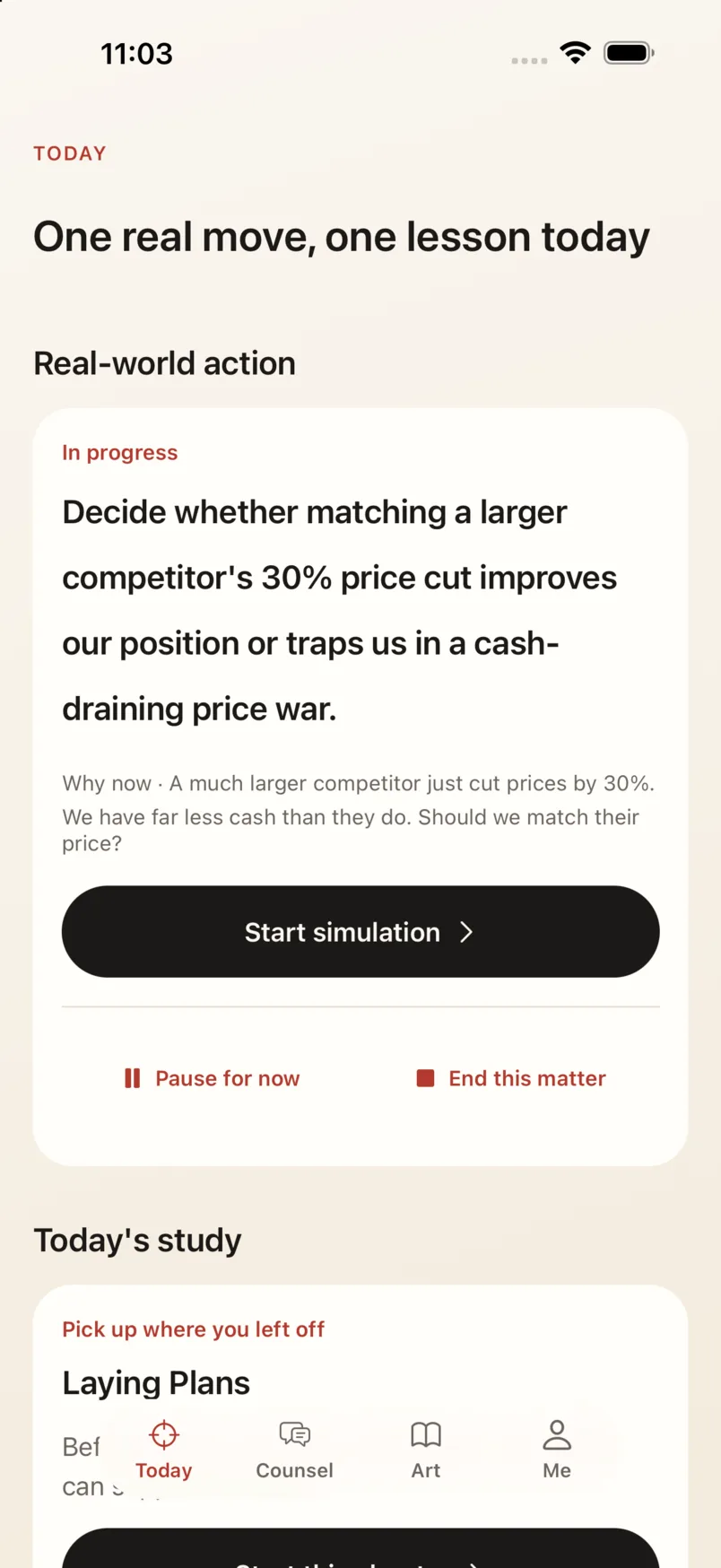
No download needed
Run one right here
This runs the same calculation the app does. Drag the sliders to score yourself and watch where the conclusion flips.
A rival cut prices by 20%. Do we follow?
Does your own side agree on what you are doing?
Is right now a good moment to move?
Do your resources and position hold up?
Can whoever decides also judge well and deliver?
Are the rules, process and division of work clear?
They are aheadRaise “Discipline” to 5 and the conclusion flips.
Their scores are fixed here so the change is easy to see. In the app you set both sides, plus how sure you are of each factor.
Who it’s for
Business, career, classroom: the same arithmetic
Founders
“A funded rival is burning cash to buy our customers. Do we match?”
See which factor you lost and which you did not before you spend a dollar.
Anyone with a boss
“Salary talk next week. What cards do I hold?”
Score yourself and the company side by side, and the factor that gives you leverage stands out.
Team leads
“Do we push into a rival’s turf? The team is split.”
Score the five factors and the two camps usually turn out to be arguing about one.
MBA students
“Case study. Who’s ahead comes down to gut feel.”
Five factors, two sides, one conclusion, and a case analysis with something behind it.
How it works
The whole app is three steps
Step one
Write it down
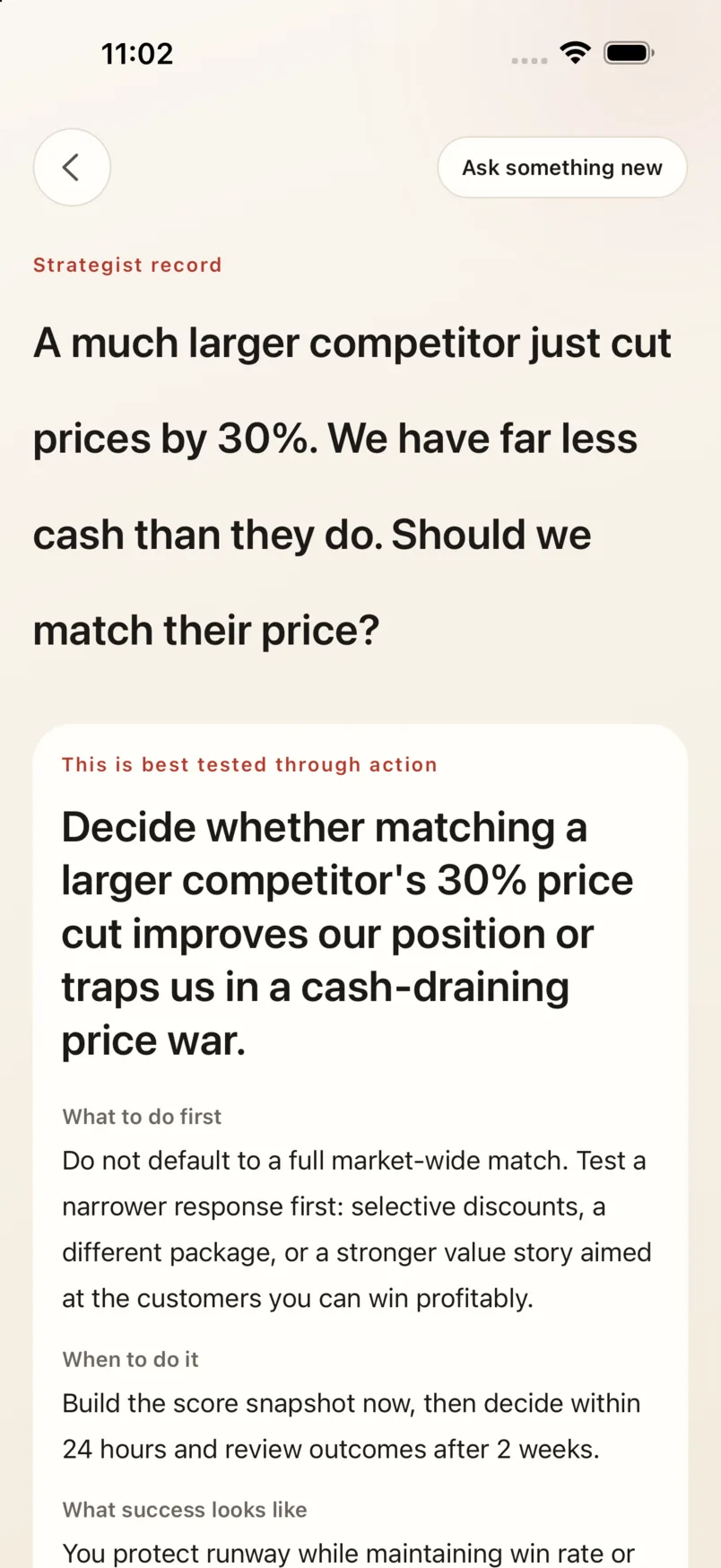
One or two sentences is enough. It picks the chapter your situation belongs to and answers you from that chapter.
You writeA much larger competitor just cut prices by 30%. We have far less cash than they do. Should we match their price?
It answers
Attack by StratagemHierarchy of Attack
Do not default to a full market-wide match. Test a narrower response first: selective discounts, a different package, or a stronger value story aimed at the customers you can win profitably. Build the score snapshot now, then decide within 24 hours and review outcomes after 2 weeks. You protect runway while maintaining win rate or retention in your priority segment without triggering a broader margin collapse.
Thus the highest form of generalship is to baulk the enemy's plans; the next best is to prevent the junction of the enemy's forces; the next in order is to attack the enemy's army in the field; and the worst policy of all is to besiege walled cities.
Break their plan first. Break their alliances next. Fight their army after that. Storming the walls is the last resort, and the most expensive one.
The Counsel tab Step two
Score both sides
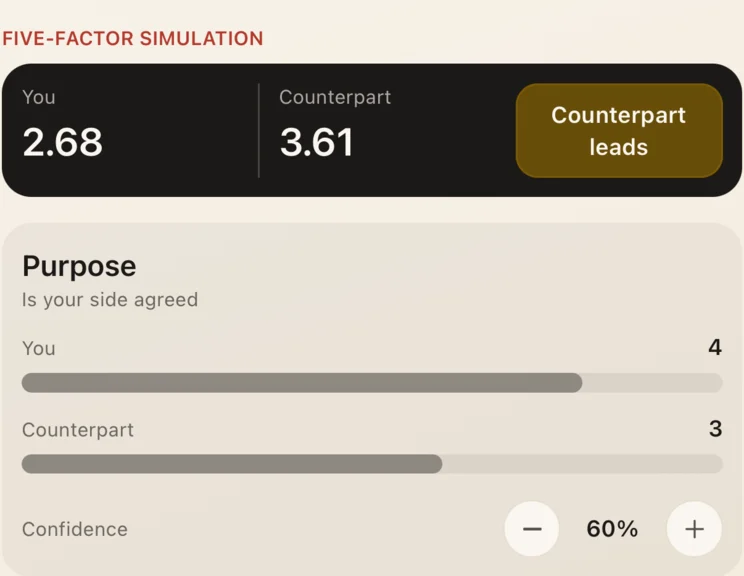
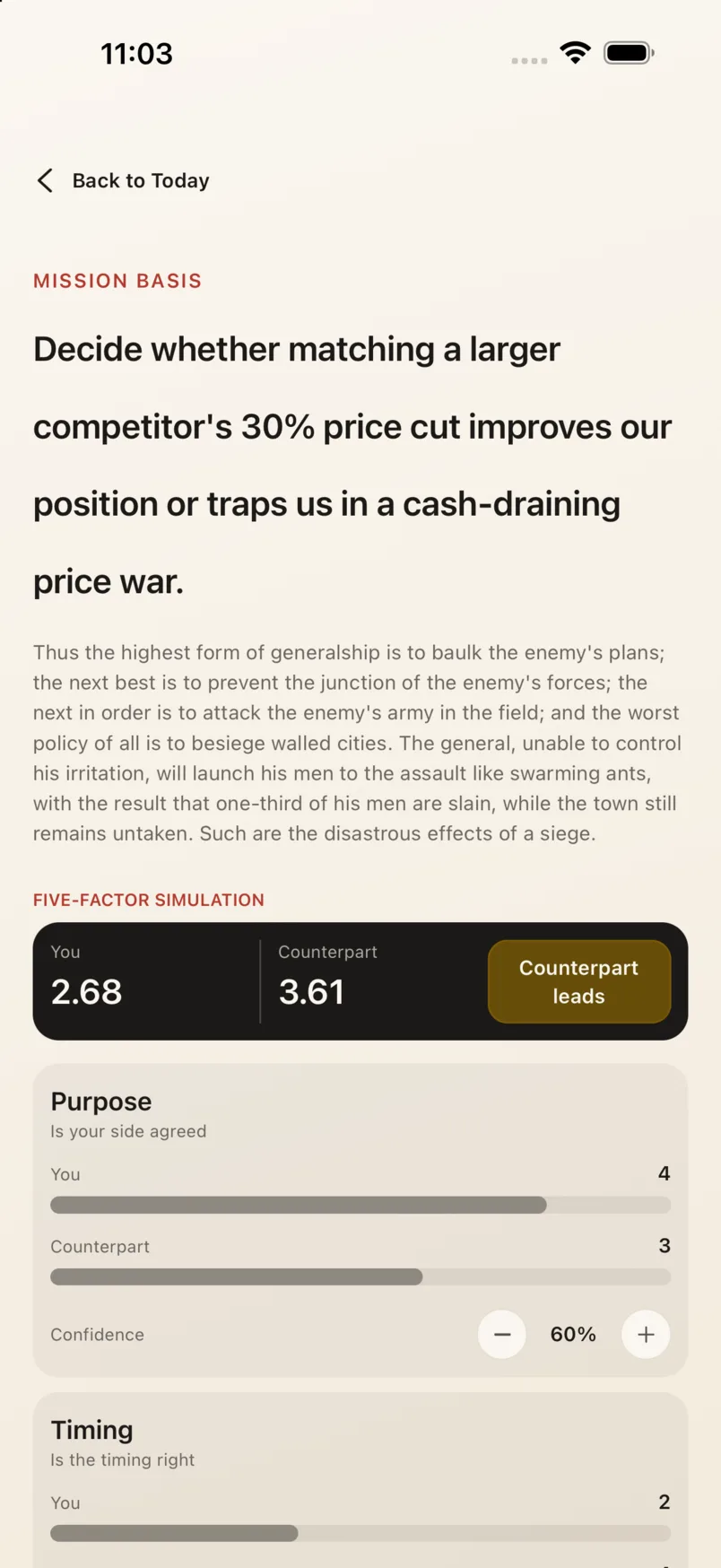
Purpose, timing, position, leadership, discipline. You score both sides on each one, and the app works out who is ahead and which factor decides it.
You2.68Them3.61They are ahead
- 道Purpose4 : 3
- 天Timing2 : 4
- 地Position3 : 2
- 将Leadership3 : 3
- 法Discipline2 : 5
The five-factor comparison Step three
Do one thing today
One action you can finish today, with the reason it comes now. Report what happened and the app gives you the next one.
In progress
Decide whether matching a larger competitor's 30% price cut improves our position or traps us in a cash-draining price war.
Why now
A much larger competitor just cut prices by 30%. We have far less cash than they do. Should we match their price?
The Today tab
First, what the book is
What is The Art of War?
A short book on strategy written about 2,500 years ago by Sun Wu, a general in ancient China. It has thirteen chapters and runs to a little over six thousand characters. Its subject is judgment: how to read a situation before you act, how to prepare, and when to leave a fight alone. Because it teaches a way of judging, people have used it for business, negotiation and competition ever since.
- Author
- Sun Wu, known as Sun Tzu, a general in the state of Wu
- When
- Around the fifth century BC
- Length
- Thirteen chapters. You can read it in an afternoon
- Today
- Taught in military academies and business schools, translated into dozens of languages
Why The Art of War
2,500 years, and the situation has not changed
Incomplete information, limited resources, and an opponent who gets to react. That situation is the same today, and only the setting has changed. The thirteen chapters keep answering one question: what to count before you act. The book is a fixed framework, and the five factors are always the same five, which is why they fit into the thing you just dragged.
If the count made before the battle shows you will win, it is because you counted more. If it shows you will not, it is because you counted less.
Count before the battle. The side with more in its favour wins; the side with less loses.
Also inside
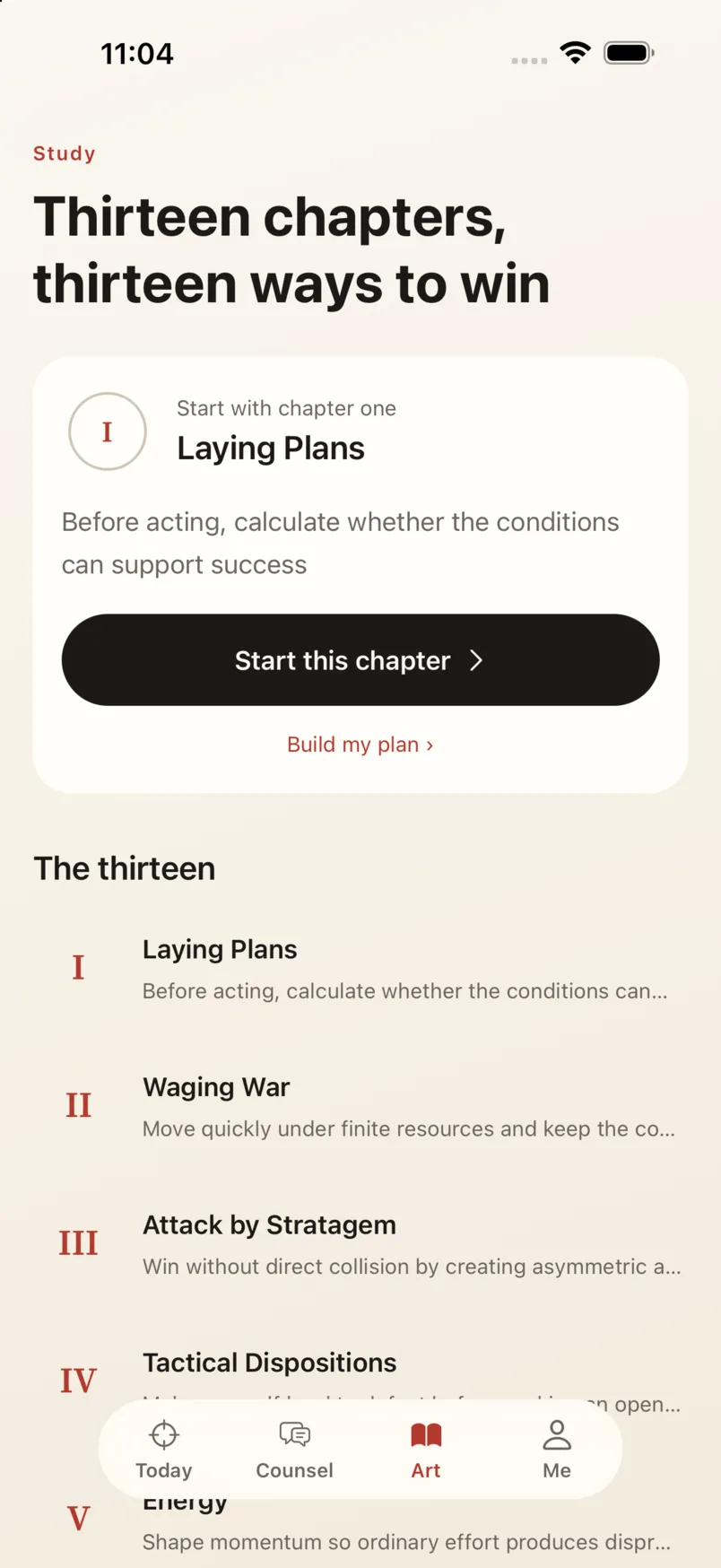
All thirteen chapters are in there
All thirteen chapters have a working example. Laying Plans and Attack by Stratagem can be read in full; the others start with the key lines.
- Original and plain reading side by side
- Every chapter comes with an example you can use
- A 21-day plan if you would rather read it straight through
Before you download
What it will not do
Will it decide for me?
No. It lays out where each side is strong and weak, then points at the factor that decides it. The choice stays yours, and so does the result.
Is this fortune telling? Does it predict the outcome?
No. You put in the scores and the app applies a fixed rule to them, so a changed score changes the conclusion.
I have never read The Art of War. Can I still use it?
Yes. You only need to describe your own situation. The original lines and the plain reading appear where they help.
Does it work on iPhone and Android?
Both. Sign in with the same account and your history follows you.
Start today
Write down the thing you keep going back and forth on