When a competitor copies your product, first judge whether they copied the surface or the capability, and whether customers are actually leaving, before choosing speed, depth, or legal action.
The short answer
Being copied is not a disaster. It is a signal: the market has been validated, and a competitor has decided that following you is cheaper than thinking for themselves. Do not spend the first week on anger or public accusation.
Separate what they copied. Features, layout, pricing, and copy can be seen and copied by anyone. Supply chain, accumulated data, service response, and customer relationships cannot.
In most cases the right move is acceleration, not defense: ship the next version so the copier is always copying your last one, deepen what cannot be copied, and reach for legal action only when the evidence is solid and the cost is contained.
Also searching for: competitor copied my product · what to do when a competitor copies you · product copied by competitor response · competitor cloned our feature
Where people usually go wrong
Spending the time on denunciation
Publicly accusing a competitor of copying gives them free exposure and rarely changes a customer's choice. Customers buy whatever works better today, not whatever was invented first.
Hiding to prevent copying
Reducing visibility, delaying launches, and cutting demos slows your own growth first. The competitor can still buy one unit and take it apart.
Letting the copier set your roadmap
Reacting to each of their moves hands them the tempo. Watch your customers, not the copier.
Treating litigation as the only answer
Patent and copyright cases are slow, expensive, and uncertain. They can be one card in your hand. They cannot be your business strategy.
Three things to check before acting
Surface or capability
List what in your product is visible (interface, features, pricing, copy) and what is invisible (supply, data, service response, relationships). Copying usually takes only the first column.
Whether customers are actually leaving
Read the data, not the mood. Are new enquiries down? Are existing customers asking why they should not use the cheaper one? Copying without churn is noise.
Where your next version is
Without a clear next version, the copier will eventually catch up. With one, the copier is only educating the market for you.
What Sun Tzu would look at first
The Art of War, chapter 7, Maneuvering
Turn the devious route into the direct one, and misfortune into advantage.
Sun Tzu says to make the long road short and to turn harm into gain. Being copied is harm, but it validates demand, educates the market at the copier's expense, and reveals their roadmap. The way to turn it into gain is to keep them copying your previous version while you deepen what cannot be copied.
Three versions, three plays
A small competitor copied the surface
Ignore them, do not respond, do not change course. Pull your next version forward and make service and customer relationships heavier. A small rival can copy features; they cannot copy the relationship between you and your customers.
A better-resourced competitor is starting to take customers
Do not compete on breadth on their ground. Narrow to the customer segment they will not serve deeply and make expertise and response speed things their cost structure cannot match. At the same time, assess whether you hold intellectual property that works as a negotiating card, not as the only weapon.
The copying is clearly infringing and you have evidence
Preserve evidence first, then price the cost and duration of litigation. The goal of enforcement is to force a negotiation or a change, not to win a trial. Pair a legal letter with product acceleration. Do not expect a court to win the market for you.
How the app walks you through it
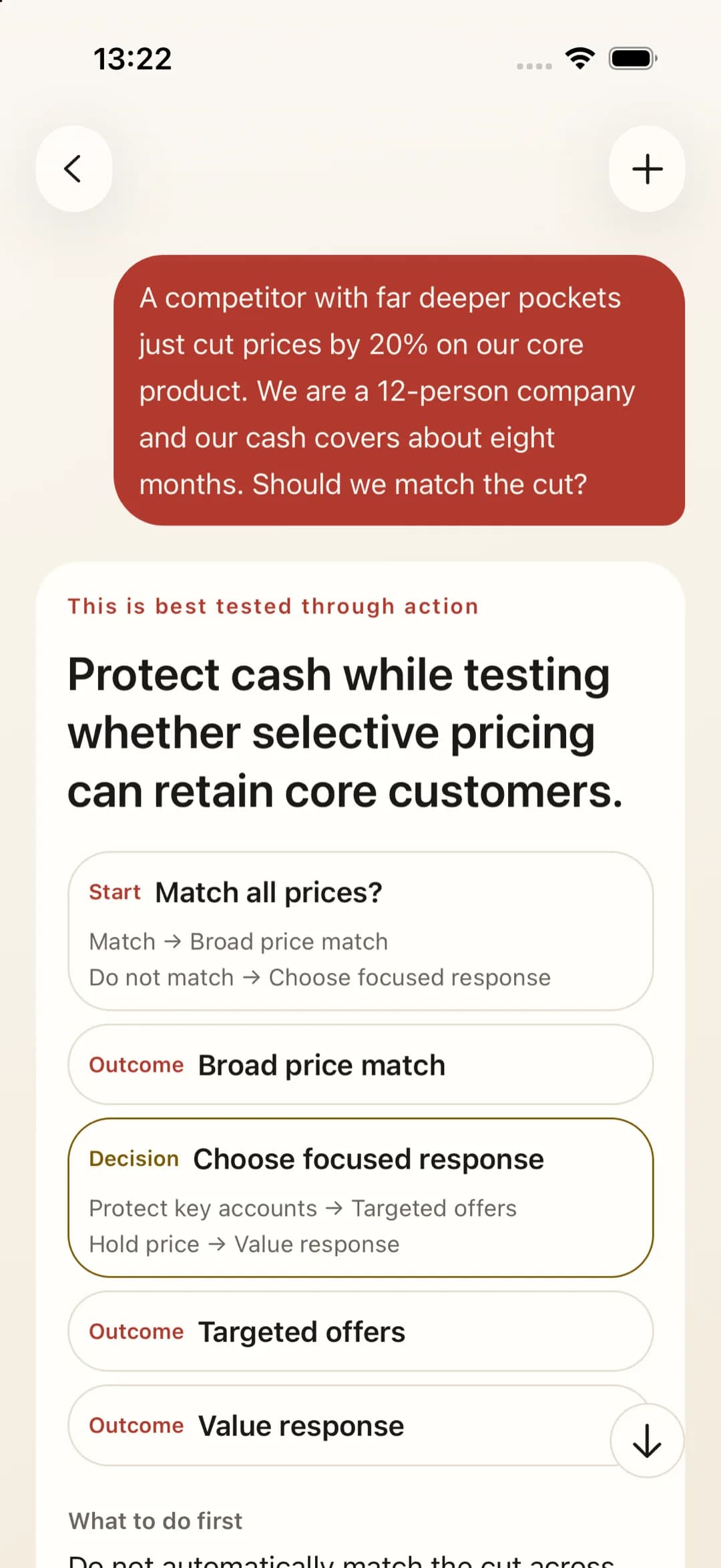
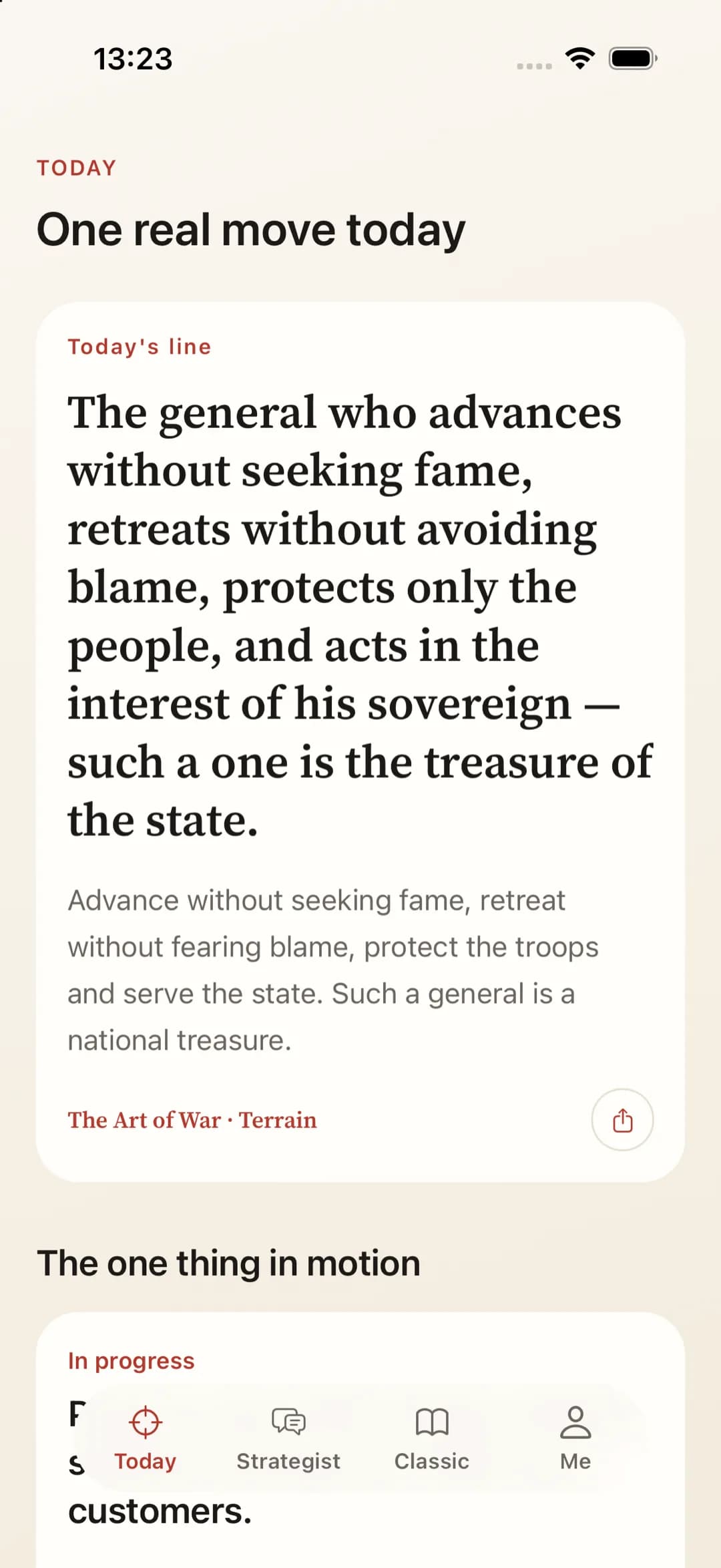
The strategist asks about your situation first, then gives a judgement and what to do firstLay both sides on the table and simulate whether the conclusion changesOne real move today, with a signal to watch
Tell the strategist who copied you, which parts, whether your customers have changed, and whether you have a next version.
The strategist splits your product into a copyable column and a non-copyable column, then weighs the competitor's resources and tempo to judge whether this is noise or a real threat.
You leave with an action card: the one thing to accelerate this week, and a signal that tells you when to reassess.
This page covers the order of judgement. Your own situation, opponent, and resources are worked through with the strategist in the app.
Usually not. Public accusation gives the competitor exposure and makes you look defensive. If you must, state facts and evidence only, without emotion, and say it once.
Should I file patents to stop copying?
A patent is a card, not a shield. It raises the cost of copying and helps in negotiation, but filing is slow and enforcement is expensive. The core defense is still tempo and capability that cannot be copied.
The copy is also cheaper than my product. What then?
Then you are competing on the same thing. Change the object of comparison: bundle service, delivery, and relationship so that the customer is no longer comparing the price of one feature.
How do I tell whether the copying is a real threat?
Two things: whether customers are actually leaving, and whether the competitor can keep up with your next version. Neither means noise; both means it is time to change strategy.
This page covers the order of business judgement and is not legal advice. Enforcement involving patents, copyright, trade secrets, or unfair competition requires a qualified intellectual property lawyer.