How to respond to a price war: should you match a competitor's price cut?
When a competitor cuts prices, first work out which of your customers they are attacking and how long they can sustain it. Three conclusions, common mistakes, three checks, and three plays.
The short answer
Do not decide whether to match on the day the competitor announces the cut. A price war is not won on price. It is won by whoever's cash and customer base can last longer.
Answer three questions first: which segment of your customers they are attacking, how long they can hold that price, and why your existing customers stay with you.
In most cases the right move is not a blanket match. It is a limited, reversible response in the segment under attack, while you move resources to where the competitor cannot reach.
Also searching for: price war response · competitor undercutting · competitor cut prices what to do · should I match a competitor's price
Where people usually go wrong
Matching across the board
A competitor may have cut one loss-leader; you hand over the margin on your whole line.
Letting fear set the tempo
Rushing to respond because you are afraid of losing customers lets the competitor decide when and how much you act.
Comparing prices instead of endurance
If the attacker has more cash or lower costs, the longer you match, the more you lose.
Forgetting why customers stay
They usually stay for delivery, service, relationships, and switching costs, not because you are cheapest. A blanket cut tells them you were only ever worth that price.
Three things to check before acting
Which segment is under attack
Split customers by tier. If you are losing price-sensitive new buyers, let them go. If you are losing core accounts, that is where to defend.
How long they can hold
Look at the competitor's funding, inventory pressure, and the scope of the cut. Cuts funded by investors have an expiry date; cuts funded by a lower cost base do not.
What makes you hard to replace
List the real reasons customers do not switch. That is your strong ground. Price is your weak ground. Do not fight the decisive battle on weak ground.
What Sun Tzu would look at first
The Art of War, chapter 6, Weak Points and Strong
Avoid what is strong and strike at what is weak.
A competitor attacking on price has chosen the battlefield where they are strongest and you are weakest. Sun Tzu's answer is not to fight harder there but to move the fight to where you are strong and they are weak: delivery, service, relationships, niche needs.
Three versions, three plays
The attacker is a funded new entrant
Do not match broadly. Offer a time-limited, conditional discount only to the segment under attack, tied to an annual contract or a value-added service, and stretch the clock until their funding cycle ends.
The attacker is an established rival with lower costs
You cannot win on price. Retreat into segments they do not want to serve, such as small batches, customization, and fast delivery, and reprice from unit price to packaged solution so the comparison loses its baseline.
The attacker is clearing inventory
This is short-term. Reassure core customers, tell them plainly you are not matching, and prepare a counter-move for one or two months out, when their stock is gone and prices recover.
How the app walks you through it
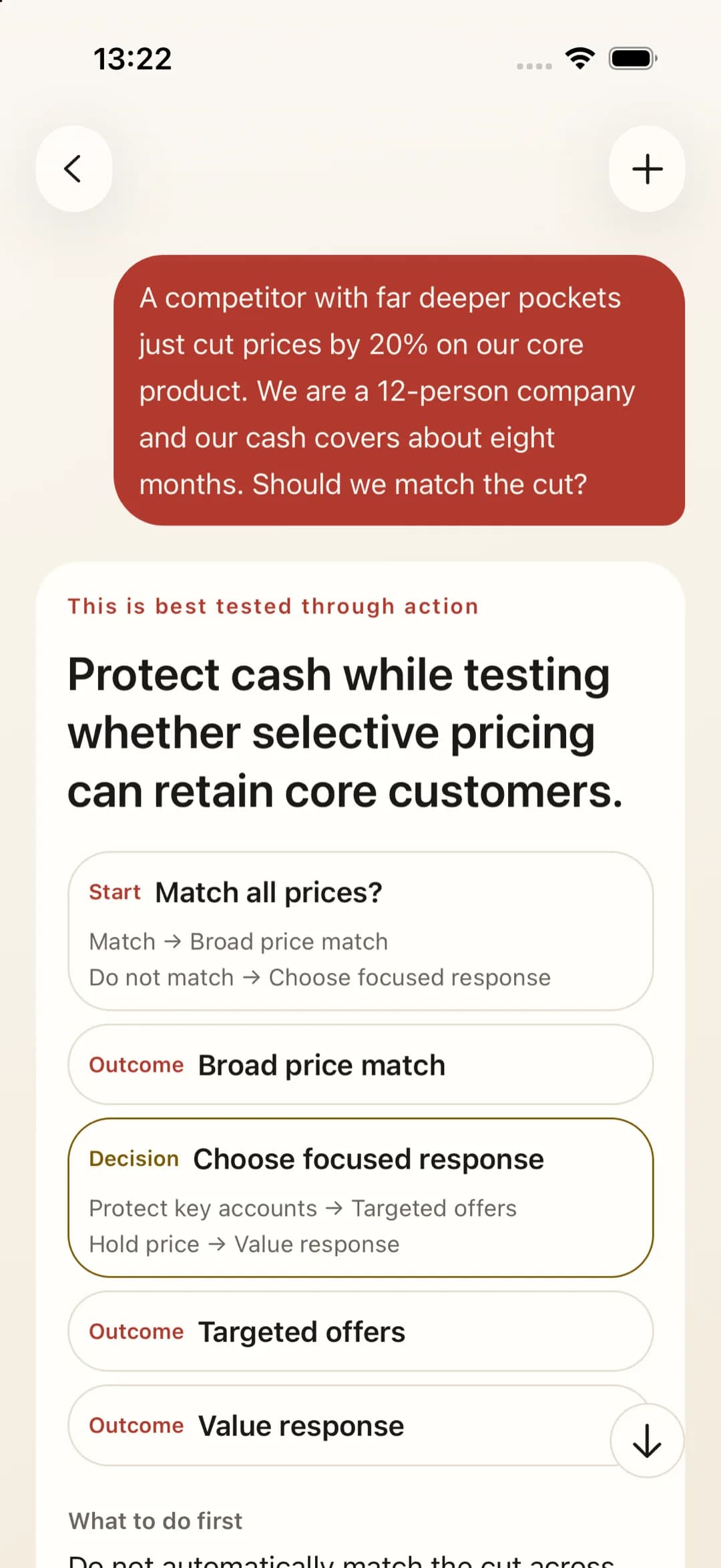
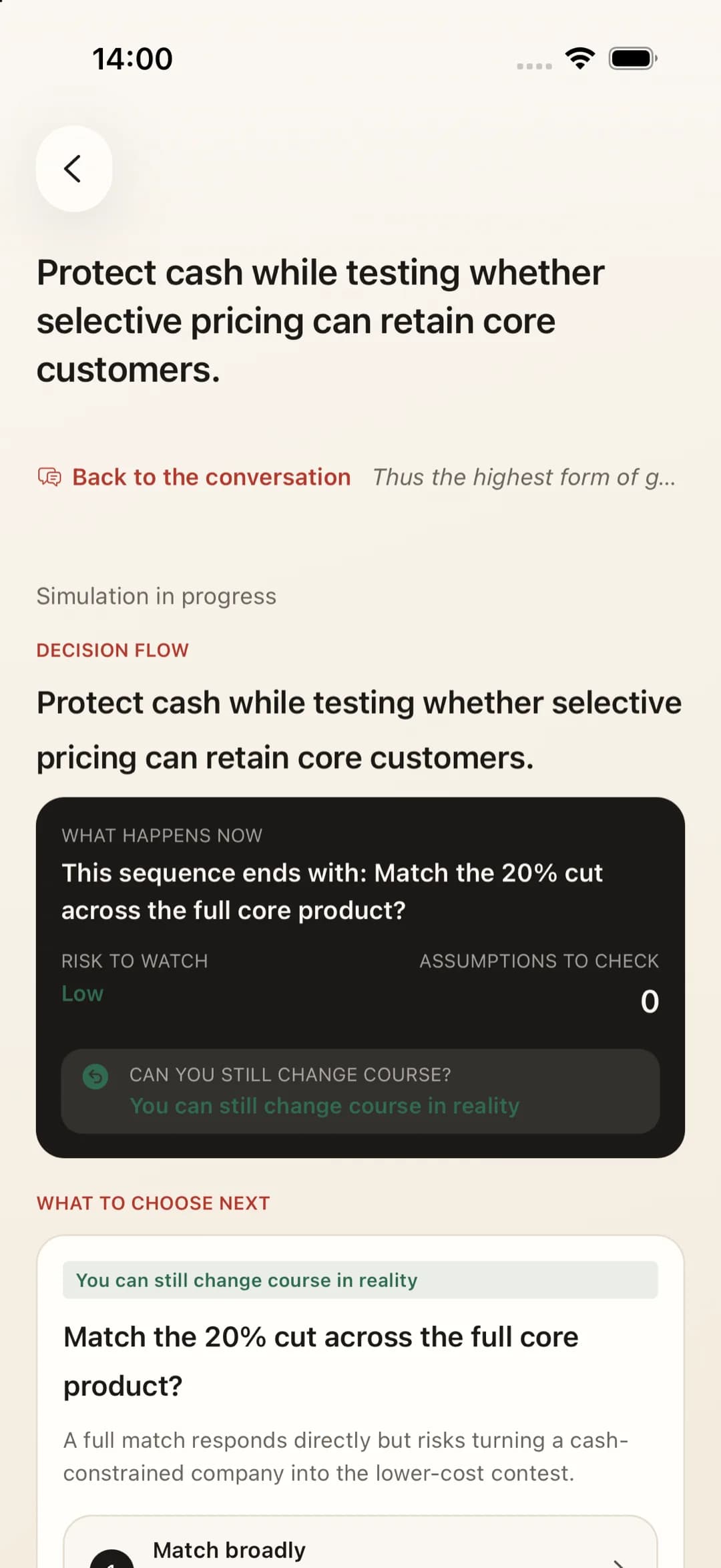
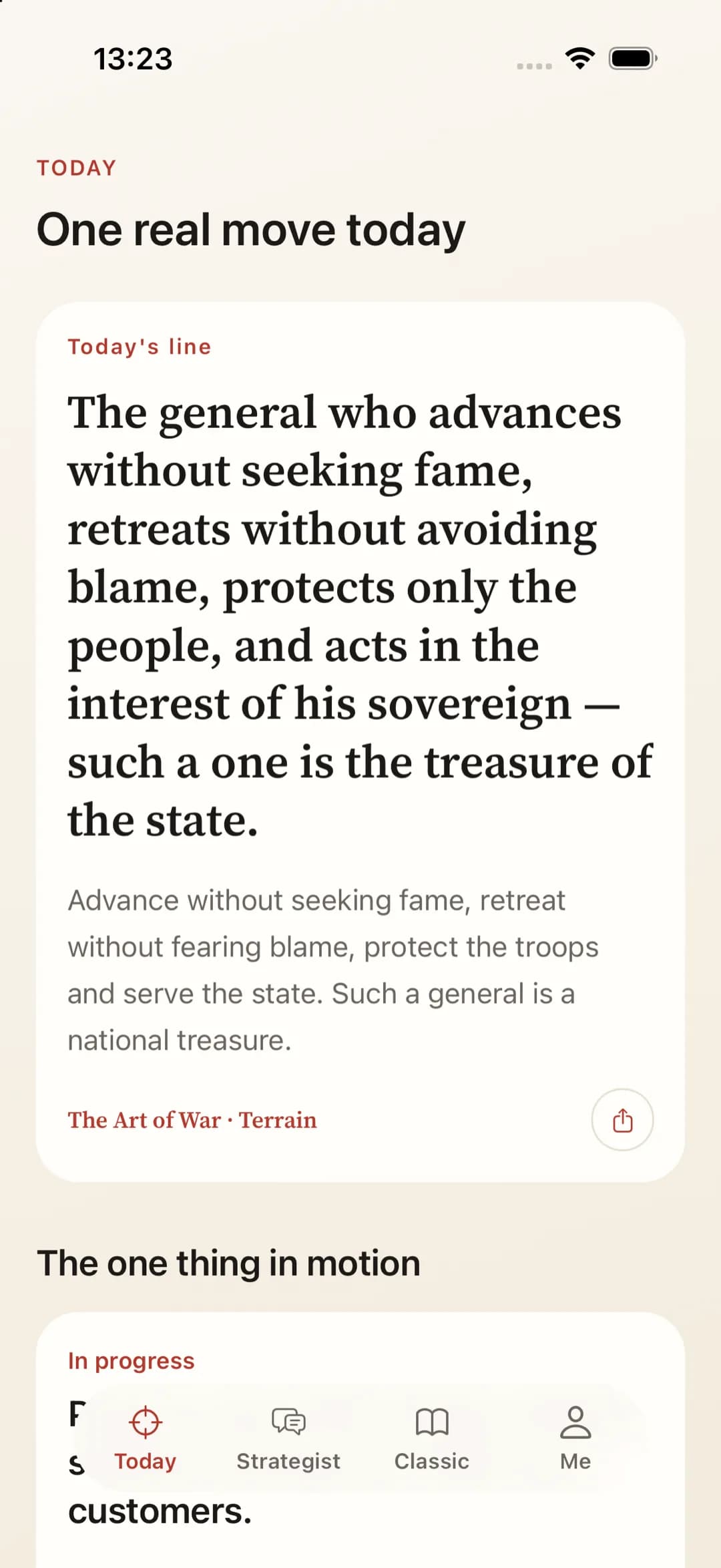
The strategist asks about your situation first, then gives a judgement and what to do firstLay both sides on the table and simulate whether the conclusion changesOne real move today, with a signal to watch
Describe the situation to the strategist: who cut, by how much, and which customers you are losing. The strategist asks about the competitor's funding and your customer structure before offering a view.
The strategist turns it into an offense-versus-defense simulation: cash, cost, customer loyalty, and channels on both sides, so you can see where you are strong and where they are exposed.
You leave with an action card: one thing to do this week, and a signal that tells you when to stop.
This page covers the order of judgement. Your own situation, opponent, and resources are worked through with the strategist in the app.
A competitor cut prices by 20%. If I do not match at all, will I lose the market?
You will lose some price-sensitive customers, and you could not have kept them anyway. What matters is whether core accounts leave, and that depends on delivery and relationships, not a 20% gap. Measure core churn first, then decide on a limited response.
How does a small company survive a price war with a large one?
Do not compete on scale on their home ground. Find the segment they will not serve: smaller batches, faster response, closer customization. Their cost structure stops them from doing this. That is your strong ground.
How long do price wars usually last?
It depends on the attacker's funding. Investor-funded price wars usually last one or two funding cycles. Cost-driven price wars do not end, which means you need to change battlefield rather than wait it out.
When should I start a price war myself?
Only when your costs are clearly lower, your cash clearly deeper, and the goal is to push a competitor out of a specific segment rather than a broad attack. Otherwise you are simply cutting prices for customers together with your competitor.
This page covers the order of judgement. It does not replace professional review of your finances, contracts, or legal exposure. Pricing conduct covered by antitrust or anti-dumping rules requires qualified advice.