Entering a new market: three things to settle first
Before entering a new market, settle whether your home base can survive a failed attempt, who defends the new market, and what capability travels with you.
The short answer
The first question about a new market is not how big it is. It is whether your existing market can absorb a failed attempt. Expansion your home base cannot survive is luck if it works and everything if it does not.
The second question is who already holds the new market, how firmly, and what it costs their customers to switch. A market with no defender usually has a reason nobody has noticed.
The third question is what you win with: capability you carry over from home, or things you must learn from scratch. The more you can carry, the cheaper the probe. In most cases, buy information with small reversible moves before committing.
Also searching for: entering a new market strategy · should we expand into a new market · how to enter a new market as a small business · new market entry checklist
Where people usually go wrong
Letting market size replace judgement
A large market in a report does not mean a large share for you. What you can take is the slice the defender does not want and your capability can reach.
Treating home success as a passport
Winning one market relied on that market's relationships, channels, and habits. Most of those have to be rebuilt somewhere else.
Committing too much at once
Renting an office, building a team, and signing long contracts before discovering the demand is not there. The first step should buy information, not presence.
Underestimating the defender's reaction
You are entering their ground. They have relationships, pricing room, and customer loyalty, and they will not wait for you to settle in before responding.
Three things to check before acting
What your home base can absorb
If the entire new-market investment is lost, will cash, the team, or existing customers be hurt? If yes, thicken the home base before talking about expansion.
How the defender holds
Are the existing players holding by relationships, by price, or by product? Relationships are hardest to break; price is easy to break but leaves no margin; product depends on whether yours is clearly better.
What travels with you
Which of your supply chain, brand, team, and methods still work in the new market, and which start from zero? The more that starts from zero, the smaller the first step should be.
What Sun Tzu would look at first
The Art of War, chapter 1, Laying Plans
Many calculations win; few calculations lose.
Sun Tzu says the side that calculates more before the campaign wins. The calculation for a new market is not its size. It is your own base, the defender's hold, and the capability you can carry. Enter without those three settled and you are gambling.
Three versions, three plays
Home base stable, weak defender, capability travels
The best case. Commit, but still in stages: a small team for three to six months to win the first three customers, and only then build the team and sign long contracts.
Home base stable, strong defender
Do not enter head-on. Find the segment the defender does not want to serve, use the capability you carry to hold that small piece, then expand inward from the edge. The goal of entry is to avoid losing first, not to win first.
Home base unstable, but the new market looks large
Do not enter yet. A large market will still be there next year; a collapsed home base has no next year. Thicken the base, keep a minimal watch on the new market, and move when the base can absorb a failure.
How the app walks you through it
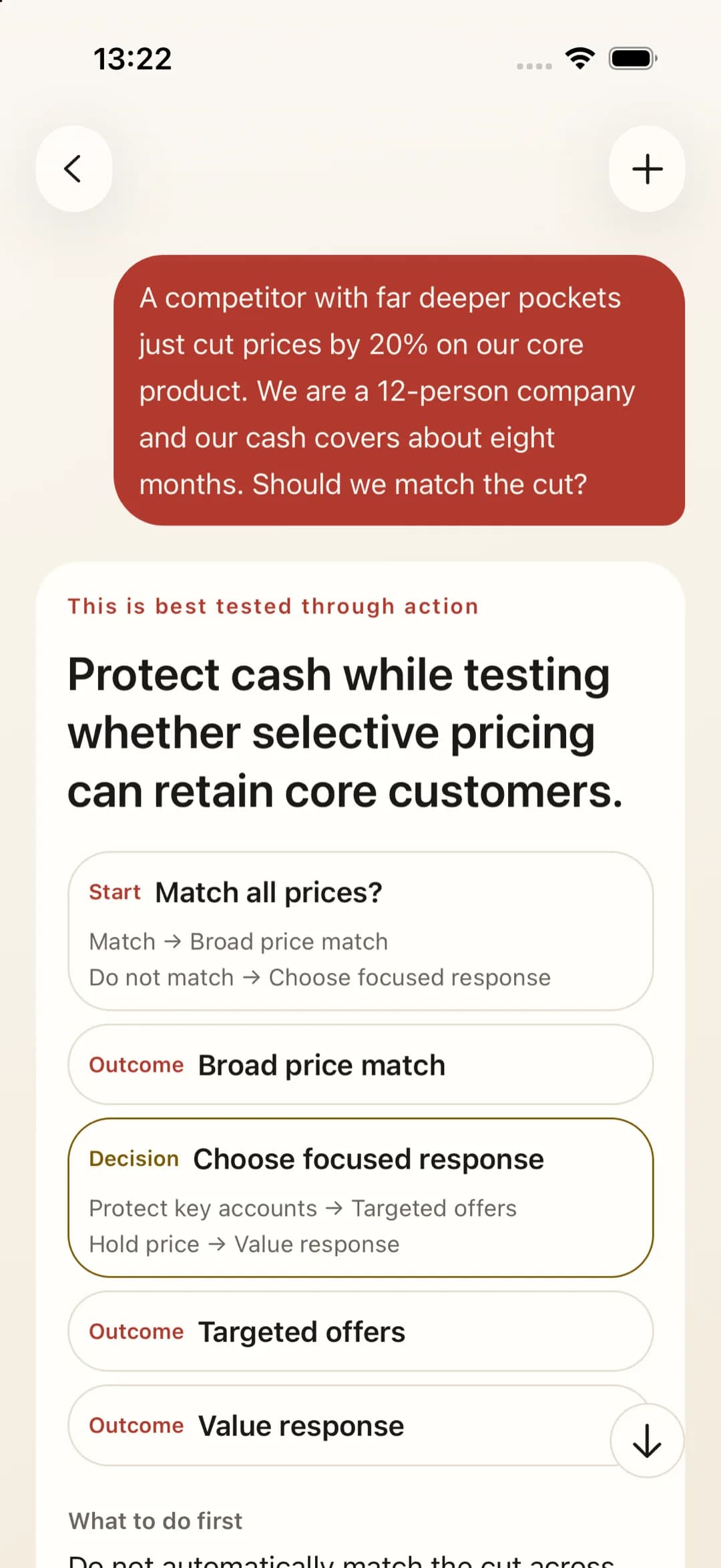
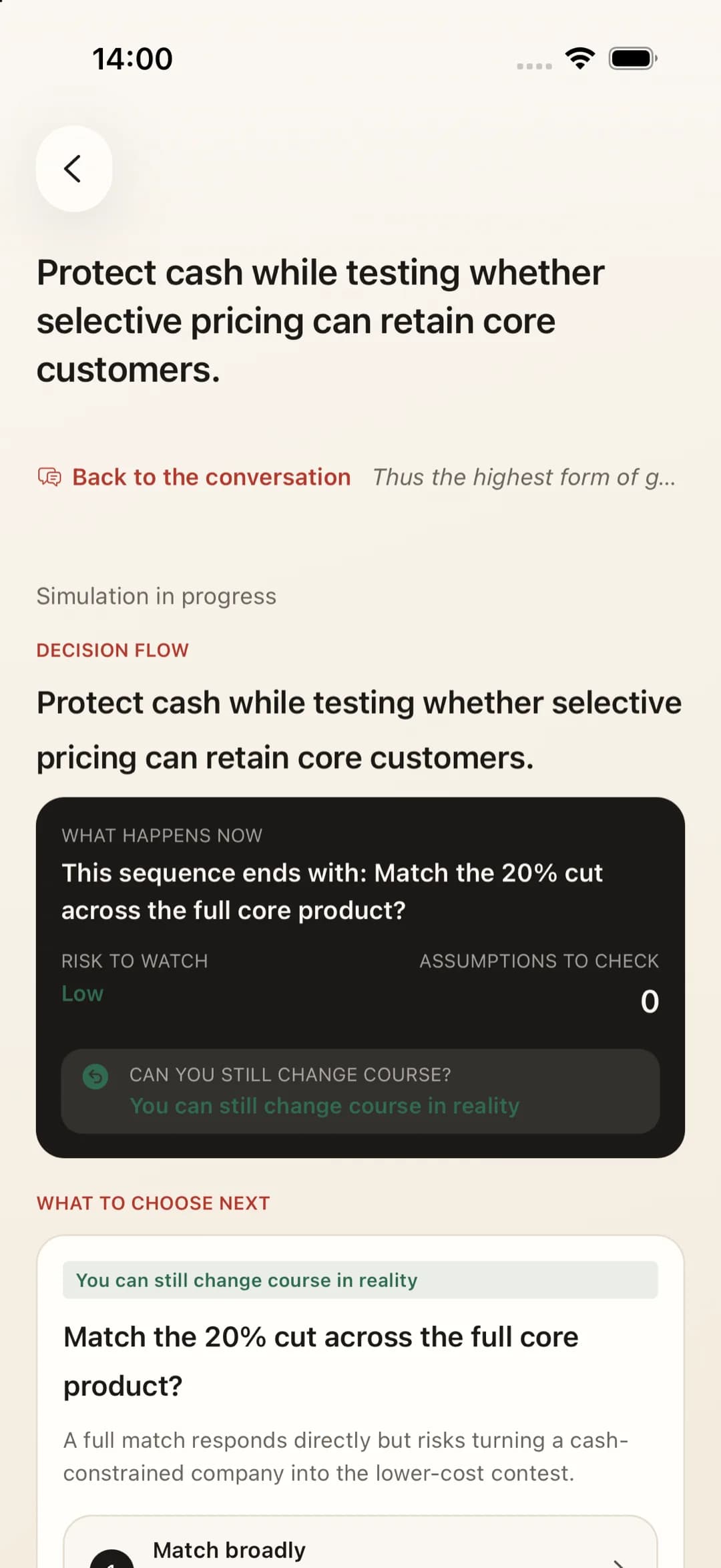
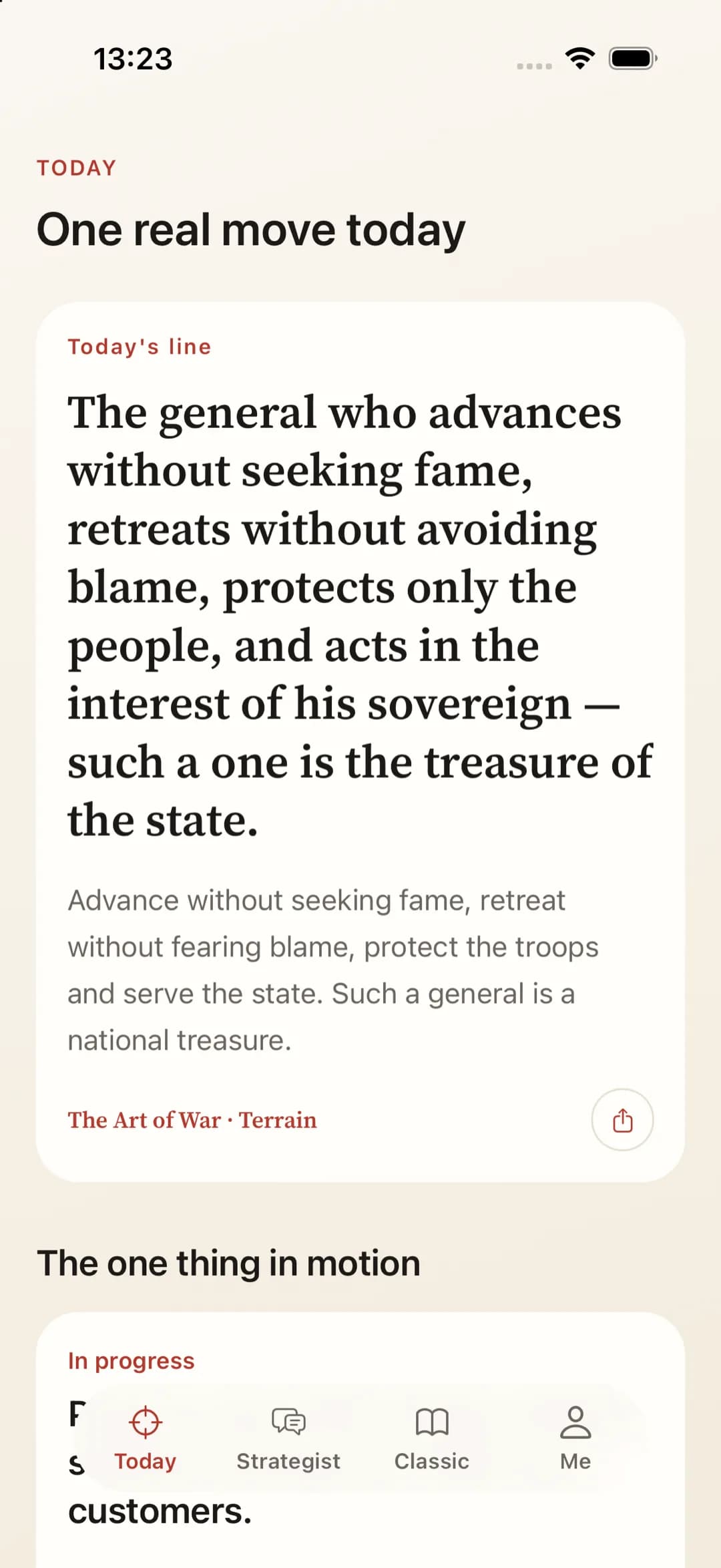
The strategist asks about your situation first, then gives a judgement and what to do firstLay both sides on the table and simulate whether the conclusion changesOne real move today, with a signal to watch
Tell the strategist the state of your home market, the market you want to enter, who is in it, and what you plan to bring.
The strategist turns it into an offense-versus-defense simulation: your base, the defender's hold, and the capability you carry, to size the first step.
You leave with an action card: one validation move for this month, and a boundary that stops further investment when a signal appears.
This page covers the order of judgement. Your own situation, opponent, and resources are worked through with the strategist in the app.
The new market seems to have no competitors. Is that an opportunity?
Be suspicious first. A market nobody serves usually has an unseen reason: the demand is not real, willingness to pay is low, or entry costs are high. Find out why nobody is there before deciding to go.
Should I start with a small pilot or commit fully?
Almost always the pilot. A pilot buys information: whether demand is real, how the defender reacts, whether your capability works. Only once you have that information can the odds of a full commitment be calculated.
Do I need a local partner?
If the defender holds by relationships, a local partner is close to essential. But first learn what the partner wants and whether they will also work with your competitor, and write the terms so you can exit.
Home growth is slowing. Should I look for growth in a new market?
Slowing growth is not the same as an unstable base. Separate saturation from share loss: share loss must be defended first; only saturation justifies expansion. Expansion must not be a way to avoid problems at home.
This page covers the order of judgement and is not financial, legal, or investment advice. Operating across regions involves tax, compliance, and employment-law differences that require qualified professionals.