When a big company enters your niche, judge whether they are serious or casual and what their cost structure cannot do, then narrow, deepen, or ride the wave.
The short answer
When a big company enters your niche, the first thing to judge is whether they are serious or casual. A casual product is abandoned after one or two budget cycles; a serious one keeps getting funded. Read their organization, not their launch event.
The second thing is to find what their cost structure cannot do: small customers, deep customization, fast response, unglamorous segments. Their advantage is scale, and the price of scale is giving up whatever scale cannot reach.
In most cases the right move is not confrontation but concentration: pull resources into the piece they cannot serve and make it something customers cannot leave. At the same time, prepare for the possibility that their entry educates the market for you.
Also searching for: big company entered my market · how to compete with a large competitor as a small business · large competitor launched the same product · incumbent entering our niche
Where people usually go wrong
Fighting on every front
Matching a big company on features, price, and channels at once spreads every one of your resources thin while each of theirs is thicker than yours.
Pivoting in panic
Abandoning the niche the day of their launch gives away a market you already validated. Most big-company new ventures do not survive two years.
Pretending they do not exist
Not watching their moves or asking customers how they react, until customers start using their price to push you down.
Betting on being acquired
Acquisition is one possible ending when a big player enters, but it cannot be your strategy. Only a company that does what they cannot do is worth acquiring.
Three things to check before acting
Serious or casual
Does the product have a dedicated team and owner, its own sales force, and a sustained presence in front of customers? A launch event without an organization behind it is casual.
What their cost structure cannot do
Their salespeople will not travel for a small order, their product will not be customized for one industry, and their support will not answer within the hour. Those gaps are your terrain.
How customers actually react
Are customers treating them as an option or already migrating? Read renewal behavior and changes in enquiries, not what customers say out loud.
What Sun Tzu would look at first
The Art of War, chapter 6, Weak Points and Strong
We are concentrated while the enemy is divided.
Sun Tzu says that if we concentrate and the enemy divides, we can strike many against few. The big company is far larger overall, but its attention and resources are split across many businesses, and your niche is only one of them. Concentrate everything you have on the spot their divided share cannot reach, and locally you are the thicker one.
Three versions, three plays
They are casual and under-resourced
Do not change course or cut prices. Speed up so customers see you improving every month while they sit still for six. When their budget cycle ends, pick up the customers they leave behind.
They are serious and starting to take your mid-size and large accounts
Narrow to the segment their cost structure cannot serve: smaller customers, deeper industry customization, faster response. Make those relationships deep enough that they cannot copy them within six months. Stop contesting large accounts; that is their home ground.
Their entry has suddenly heated up the whole market
Ride it. They are educating the market, raising budgets, and drawing attention; you catch the demand that spills past their coverage. What matters most now is being findable when customers search the category and stating clearly how you differ.
How the app walks you through it
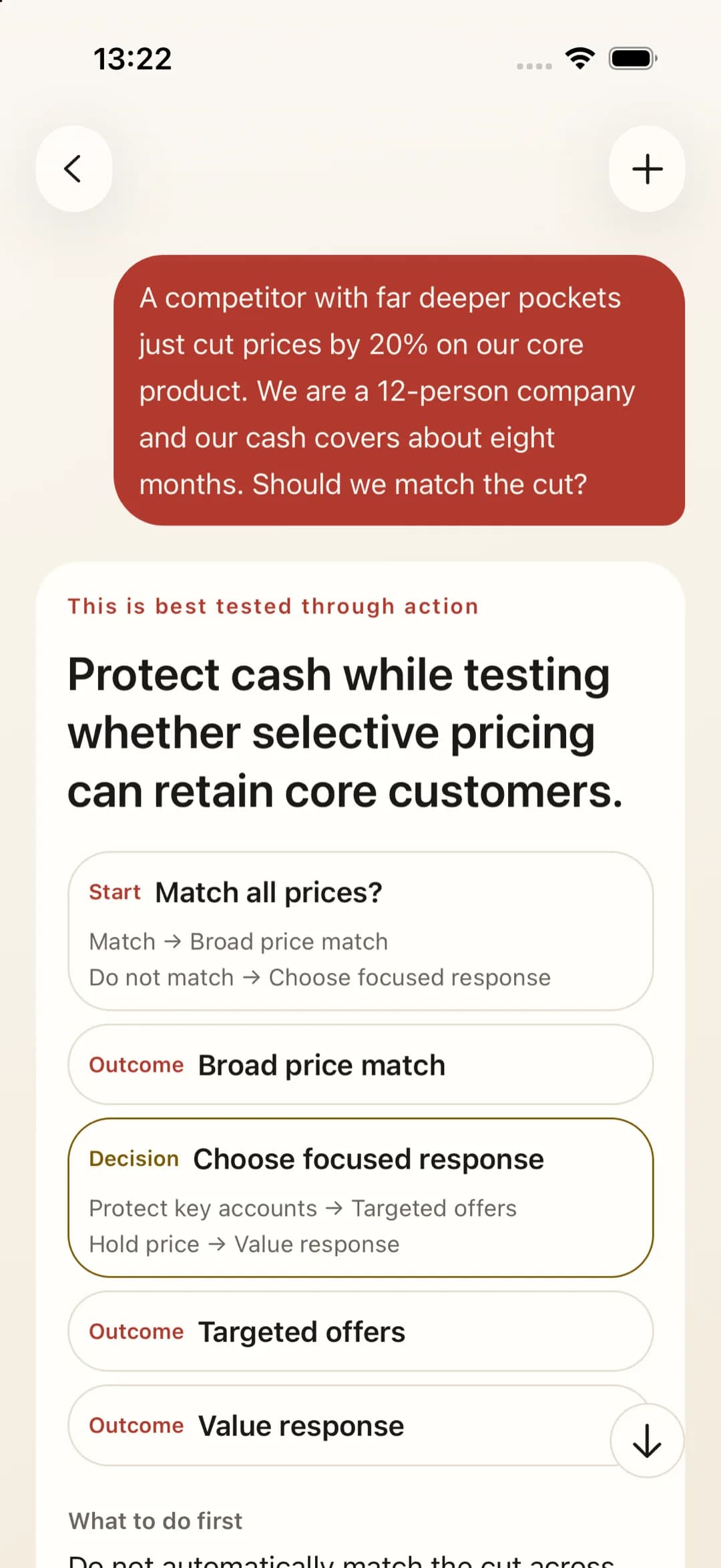
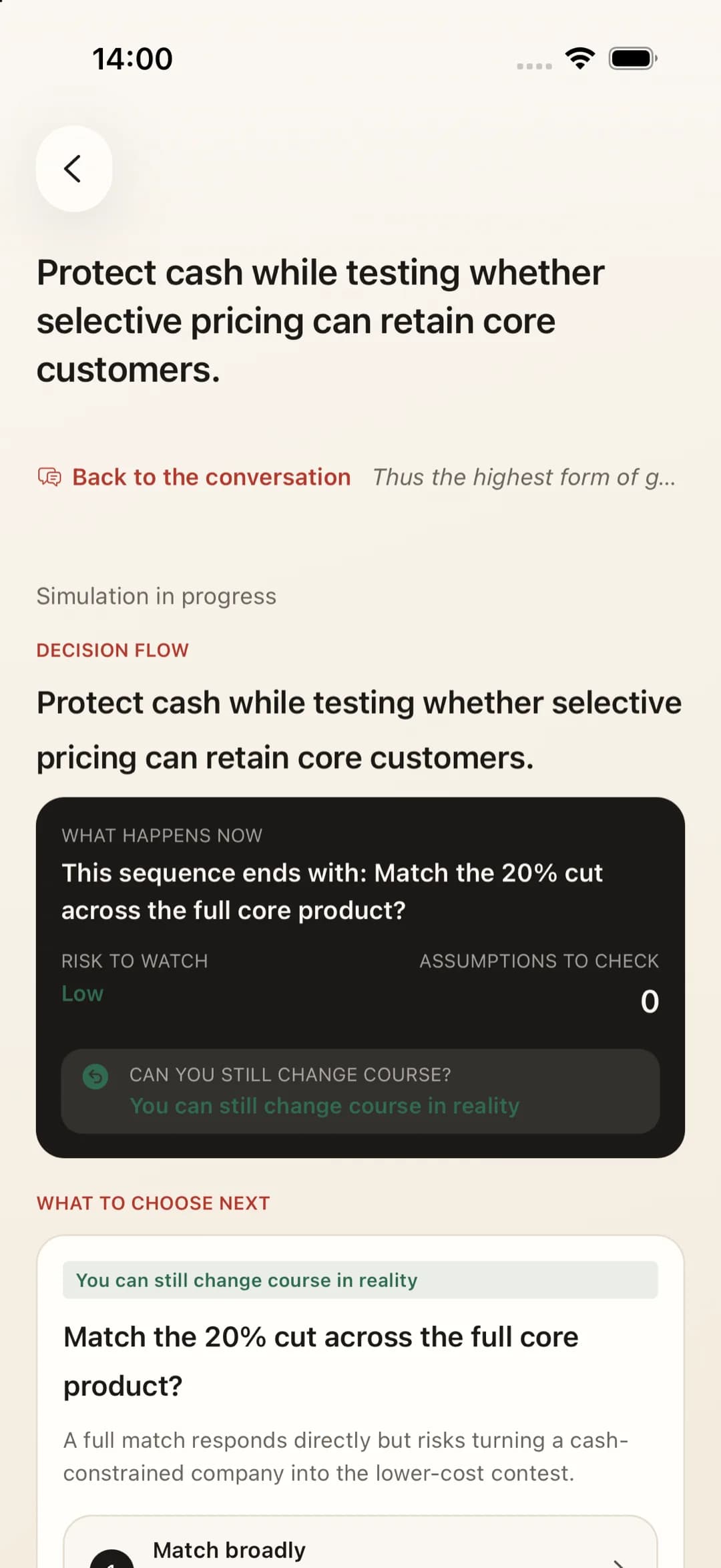
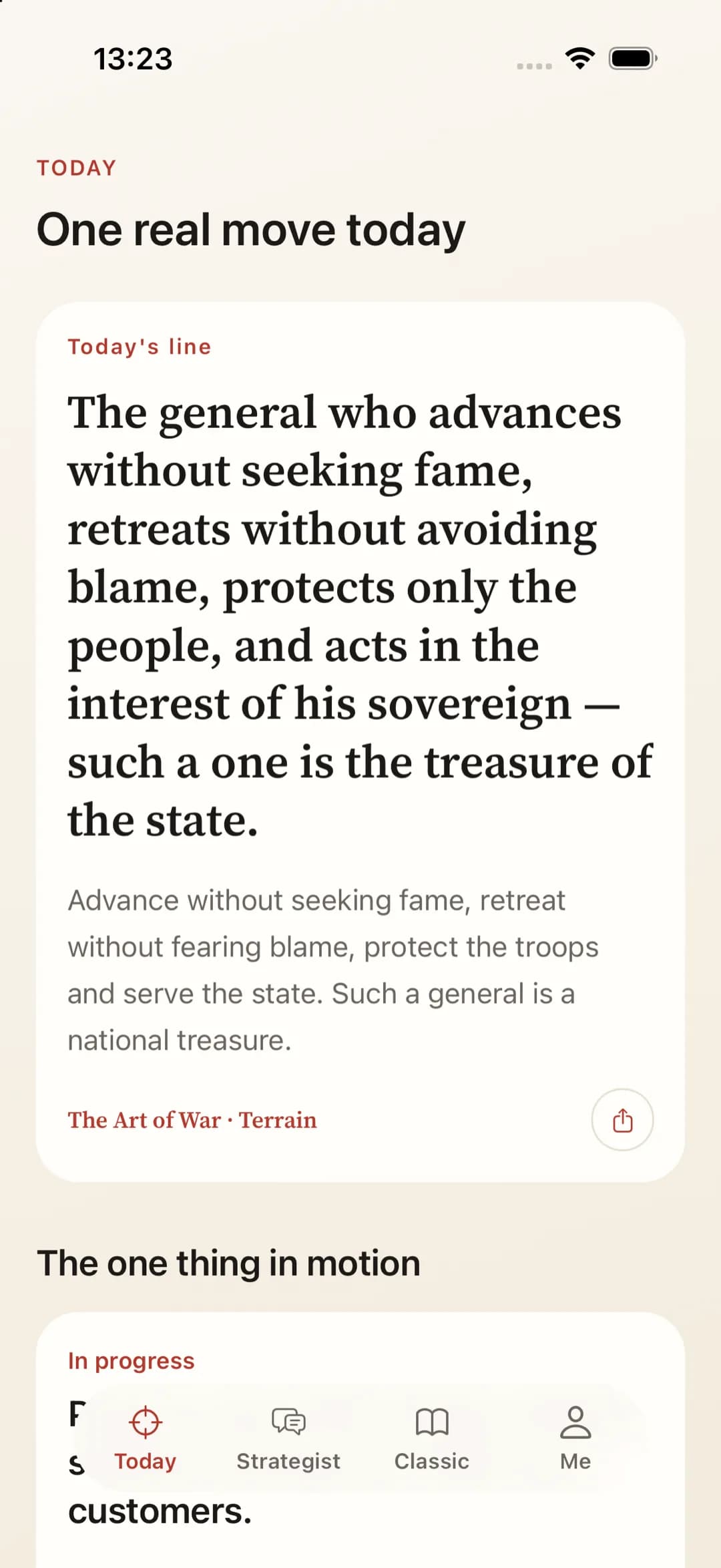
The strategist asks about your situation first, then gives a judgement and what to do firstLay both sides on the table and simulate whether the conclusion changesOne real move today, with a signal to watch
Tell the strategist who entered, what they launched, how much organization you can see behind it, and how your customers are reacting.
The strategist turns it into an offense-versus-defense simulation: resources, attention, cost structure, and customer relationships on both sides, to find the spot where they are divided and you can concentrate.
You leave with an action card: the one thing to pull resources into this month, and a signal that tells you when to reassess.
This page covers the order of judgement. Your own situation, opponent, and resources are worked through with the strategist in the app.
No. Their cash is deeper than yours and a price war is their home ground. Your price should be higher, justified by doing what they cannot: deeper customization, faster response, closer service.
How can I tell whether the big company is serious?
Read the organization, not the marketing. A dedicated team and owner, dedicated sales and support, and executives mentioning it repeatedly in earnings calls or public talks. Missing all three usually means casual.
Customers use the big brand to pressure me. What do I say?
Do not run down the competitor. Ask the customer one question: will their team answer your problem within the hour, and will they change the product for your industry? Let the customer compare what they actually need.
Should I approach the big company about partnership or acquisition?
You can, but only after you hold a depth in some segment that they cannot build. Without that depth you have no leverage, and any terms will reflect the fact that they could do it themselves.
This page covers the order of business judgement and is not legal or investment advice. Partnership agreements, acquisition talks, and antitrust matters require qualified professionals.