When your boss will not take your advice, find out what they are accountable for and what they fear, then rewrite the proposal into something they can defend upward.
The short answer
When a boss rejects a proposal, it is usually not because the proposal is wrong. It is because it does not answer the question they actually care about: how they will explain it upward, and who carries it if it fails.
The order of judgement is: what they are accountable for this quarter, how much extra risk your proposal puts on them, and whose opinions they actually listen to.
Managing up is not saying it louder. It is rewriting the proposal into a version that can be tried small, reversed, credited to them if it works and carried by you if it fails, and walking them through it privately before any formal setting.
Also searching for: boss does not listen to my ideas · how to manage up · how to get your manager to accept a proposal · manager keeps rejecting my suggestions
Where people usually go wrong
Raising it for the first time in a meeting
A boss who hears an unprepared proposal in front of others defends by reflex. Most good proposals die at this step, not on their content.
Selling the upside and skipping their risk
The bigger the proposal, the more risk it puts on them. If you do not name it, they fill in the worst version themselves.
Reading one rejection as final
No usually means not now or not in this shape, not never. Without asking which one it is, you give up.
Using other people's authority as leverage
Citing an outside expert or another executive to prove you are right turns a proposal into a question of allegiance, which makes it harder to accept.
Three things to check before acting
What they are accountable for
Find what they have promised upward this quarter and which metric they most fear breaking. If your proposal touches that line, explain first how the line is protected.
What your proposal costs them
Count the budget they must approve, the people they must move, and the people they must explain it to. That is the real price of their yes.
Whose opinions they listen to
Every boss has a few trusted sources. Knowing who they are decides whether your idea should pass through them first or go straight to the boss. The outcome differs a lot.
What Sun Tzu would look at first
The Art of War, chapter 1, Laying Plans
When the calculation of advantage is heeded, then create momentum.
Sun Tzu says to lay out the gains and losses so they can be heard, and only then build momentum. Managing up follows the same order: work out the boss's stakes first, shape the proposal so it can be heard, and momentum follows. Building momentum before the calculation mostly builds opposition.
Three versions, three plays
They agree with the direction but will not commit resources
Shrink the proposal to a pilot that needs no budget approval, get a result in two to four weeks, and return with the result to discuss scale. Let them approve a low-risk test, not a direction.
They have doubts about the direction itself
Listen to the doubts privately without arguing and write them down. Make the next version answer those exact points, and let them see in the formal setting that their view is already inside the plan.
They have rejected it repeatedly without reasons
Stop pushing the same proposal. Let the idea be discussed among the sources they trust, and write your plan into a short document on file. When the problem finally surfaces, your plan is the ready answer.
How the app walks you through it
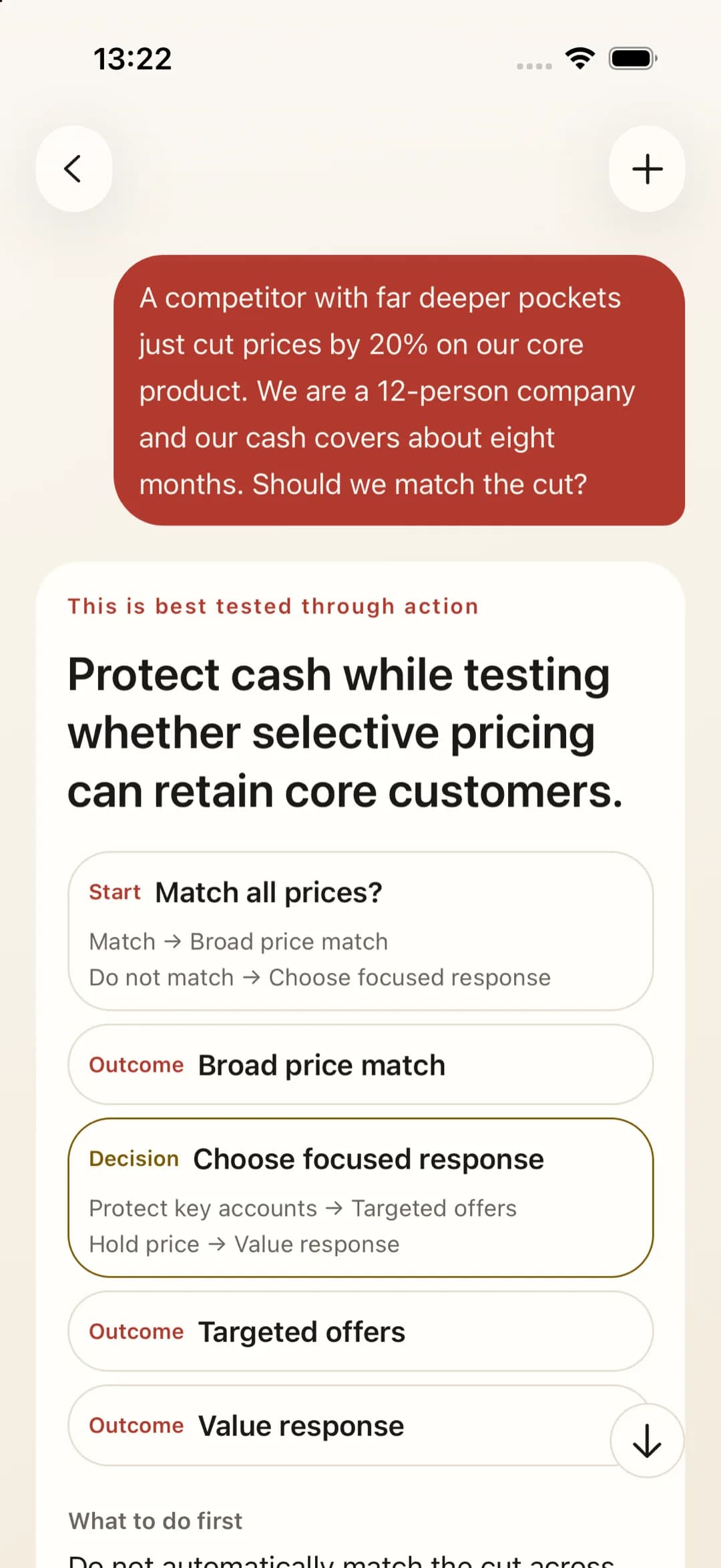
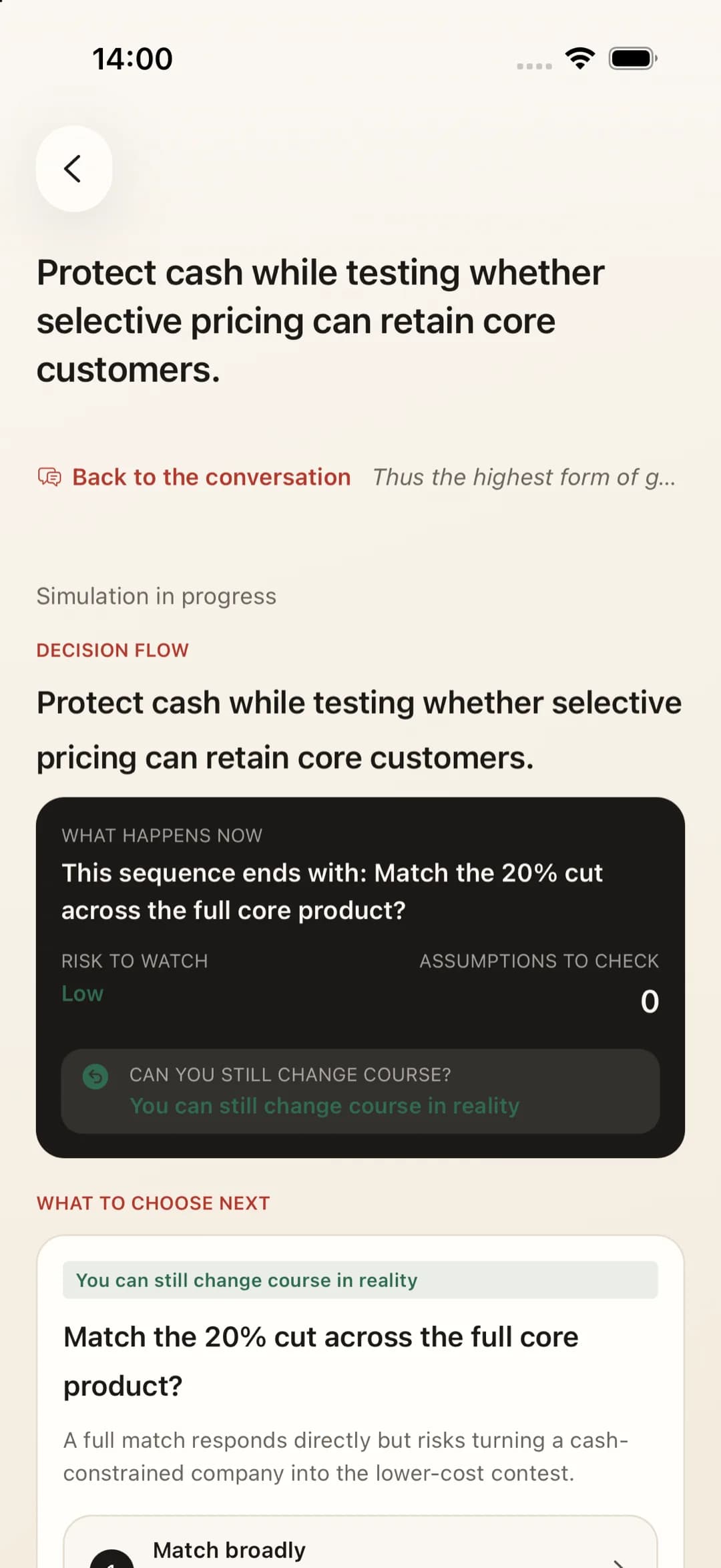
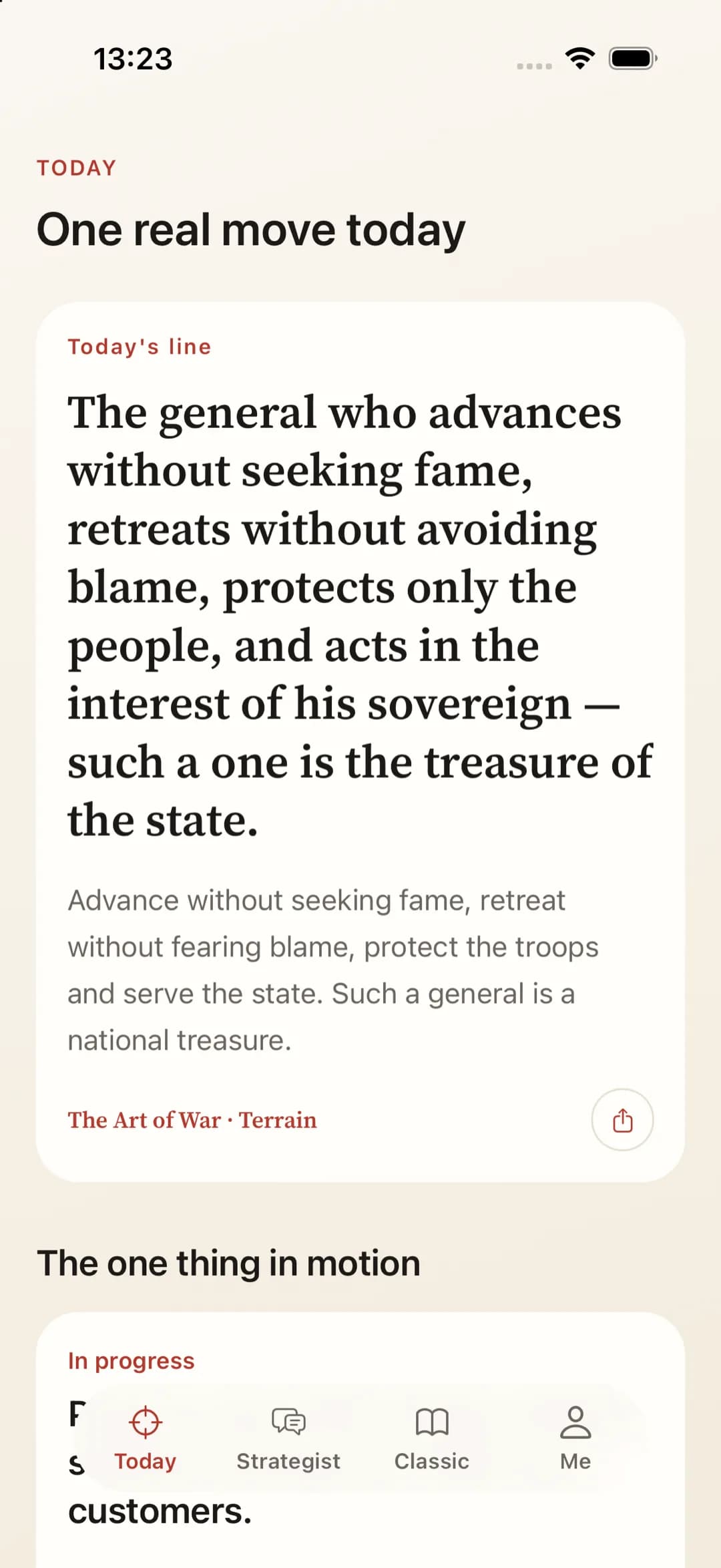
The strategist asks about your situation first, then gives a judgement and what to do firstLay both sides on the table and simulate whether the conclusion changesOne real move today, with a signal to watch
Tell the strategist the proposal, how the boss responded, what the boss is accountable for this quarter, and what you guess they are worried about.
The strategist puts the boss's stakes and your proposal on one table, showing which part touches their line and which part can become a small test.
You leave with an action card: three opening sentences for the next private conversation, and a signal that tells you when to pause.
This page covers the order of judgement. Your own situation, opponent, and resources are worked through with the strategist in the app.
My boss is plainly wrong. Do I still have to accommodate them?
Not accommodate, reroute. Pushing head-on against a wrong boss usually ends with you out, not with them changed. Turn the proposal into a cheap test and let the facts persuade them. That is faster than you persuading them.
Should I propose it in writing or in person?
Sound it out privately in person first, then write. A written proposal without groundwork reads as putting it on record, and the boss gets defensive. Once you roughly agree, the written version becomes the tool they use to explain it upward.
How long should I wait before raising it again?
It depends on the reason for the no. If it was resources, wait for the next budget cycle. If it was doubt about the direction, wait until you have new evidence. If there was no reason given, stop and observe for a quarter.
My boss adopted the idea and presented it as their own. What now?
Accept it the first time; that is part of the price of adoption. What you want is the idea implemented and the next ideas heard. Being erased repeatedly is the problem worth handling, and that is the credit-taken page.
This page covers management judgement only and is not HR or legal advice. Do not use Sun Tzu's language to justify manipulating, pressuring, or harming colleagues or managers. Instructions that break rules or the law belong in your company's formal channels.