Pivot or persist: find the evidence that would change your mind
When the business is not taking off, pivot or persist is decided by the one piece of evidence that would change your judgement, not by feeling. Three plays.
The short answer
Pivot or persist cannot be decided by confidence or fatigue. First write one sentence: what evidence would make you admit the current direction does not hold, and what evidence would confirm it does.
The order of judgement is: what the current direction has verified and what it has not, whether the remaining runway is enough for one test that gets that evidence, and whether the new direction has more evidence behind it than the old one.
Most of the time the right move is neither a full pivot nor grinding on. It is one low-cost test designed specifically to get the evidence, so the next decision rests on facts.
Also searching for: pivot or persevere · when to pivot a startup · business not growing should I change direction · how to know when to give up on a business idea
Where people usually go wrong
Treating fatigue as a signal
A year without traction, you are tired, so it feels like time to change direction. The fatigue is real, but it says nothing about whether the direction is right. Decide on fatigue and you will be just as tired in the new direction.
Treating excitement about a new idea as evidence
The new direction looks full of opportunity because you have not failed at it yet. You can see every problem in the old direction; the new direction's problems have not appeared. That is not proof the new direction is better.
Adding investment without a decision point
Three more months, one more round of money, each time just one more, without ever defining what result counts as success and what counts as failure. Persistence without a decision point is gambling under another name.
Throwing away what was already verified
A pivot is not a restart from zero. The customers, channels, and capabilities verified in the old direction are the starting point of the new one. Tearing everything down wastes the tuition already paid.
Three things to check before acting
The list of verified and unverified assumptions
Write out the key assumptions of the current direction: will anyone pay, how much, can you find these people at scale. Mark each as verified, disproved, or untested. Look only at this table, not at your mood.
The cost of getting the key evidence
Among the untested assumptions, which one forces a change of direction if disproved? What is the cheapest way to test it, how long, how much? If the runway cannot cover that test, that is a different problem: fix the runway first.
The evidence base of the new direction
Where does the pivot idea come from: something customers keep asking for, or the team's own guess? The first already carries evidence. The second is, like the old direction, just an assumption.
What Sun Tzu would look at first
The Art of War, chapter 8, Variation in Tactics
The wise leader's deliberations always blend advantage and harm.
Sun Tzu says the wise consider gain and loss together. When pivoting, seeing only the new direction's gains and the old one's losses, or when persisting, seeing only the old direction's gains and the pivot's losses, is looking at half the picture. Write both sides' gains and losses next to each other and the decision will stand.
Three versions, three plays
A key assumption has been disproved, such as repeated tests showing nobody will pay
Pivot, but only the layer that was disproved. If the price does not hold, change pricing and segment. If the need does not hold, change the problem. Carry the verified customer relationships and capabilities with you rather than starting from zero.
The key assumptions are untested; growth is just slow
Do not pivot. Run one dedicated test over four to eight weeks with a single goal: get the evidence that would change your judgement. Write the success and failure criteria in advance and decide by them when the test ends.
The old direction survives but has a visible ceiling; the new one has customer pull
Run in parallel rather than switching. Use the old direction's cash flow to fund the first validation of the new one, with an investment ceiling and a decision date. Move resources across once the new direction has evidence.
How the app walks you through it
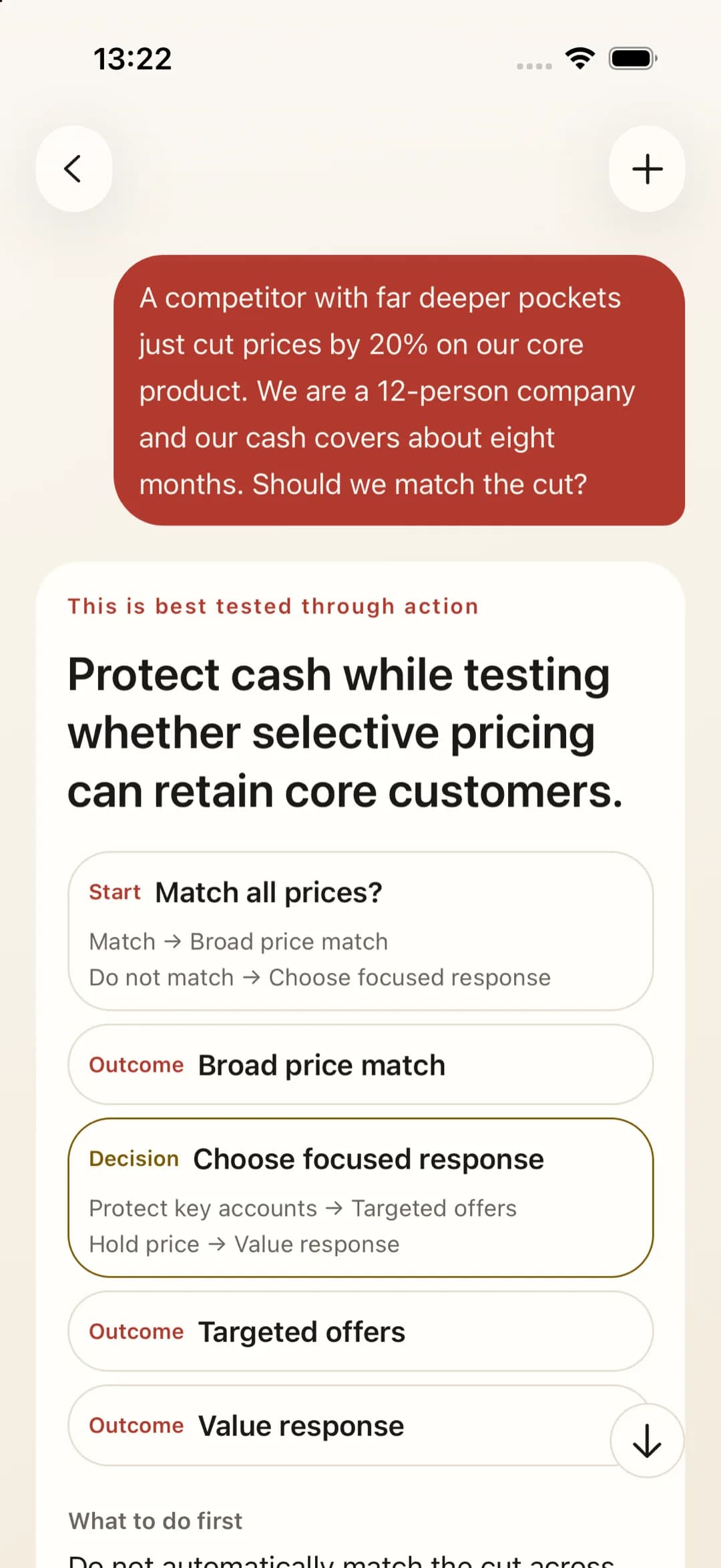
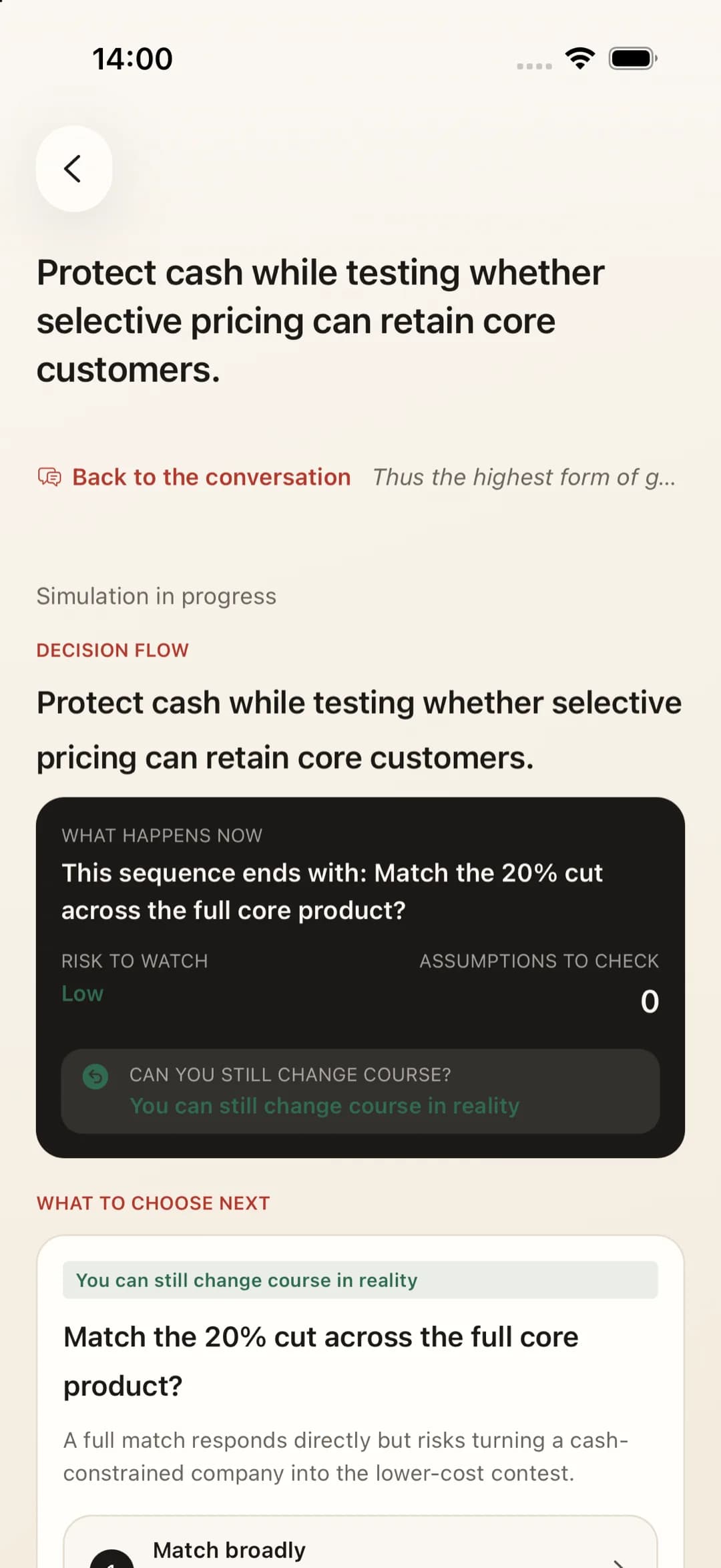
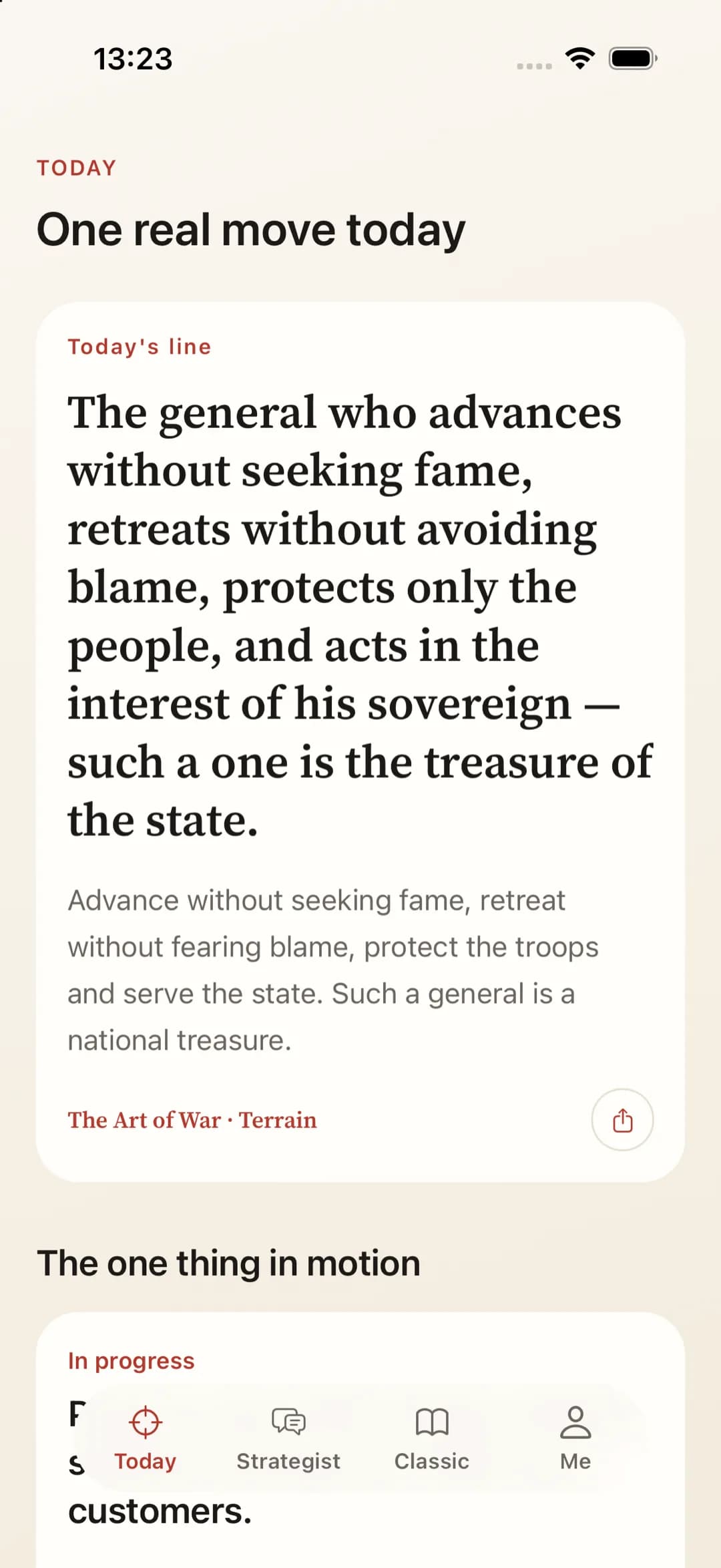
The strategist asks about your situation first, then gives a judgement and what to do firstLay both sides on the table and simulate whether the conclusion changesOne real move today, with a signal to watch
Tell the strategist the situation: how long you have been at it, current numbers, what you doubt about the direction, and where you want to pivot to.
The strategist first sorts your key assumptions into verified, disproved, and untested, then helps design one test built to get the evidence, with written success and failure criteria.
You leave with an action card: the test to run this week, and a decision rule that says which result means pivot and which means stay.
This page covers the order of judgement. Your own situation, opponent, and resources are worked through with the strategist in the app.
Time is not the standard; evidence is. Three years with the key assumptions never tested, versus three months with them repeatedly disproved: the second is the one that should pivot. Define what counts as disproof first, then talk about time.
Some of the team want to pivot and some want to persist. What then?
Move the argument from opinions to evidence. Ask the pivot side to write down what disproved the old direction; ask the persist side to write down what verified it. Usually both sides turn out to lack evidence, so go and get it first.
Our investors want us to persist, but I think we should pivot.
Bring evidence, not emotion. Show investors the list of verified and disproved assumptions and the evidence base for the new direction. What investors usually object to is not the pivot but a pivot without evidence.
What if the new direction does not work either?
This is exactly why the pivot also needs a decision point and an investment ceiling. The new direction is just as much a hypothesis and needs the same low-cost validation first. A pivot is not one bet; it is switching to a different hypothesis and continuing to test.
This page covers the order of judgement and is not financial or legal advice. Funding terms, shareholder rights, and staff arrangements require qualified professionals.