Take the project or not: look at what it will consume
Before taking a project, look at who it will occupy and for how long, and what it leaves behind. Three conclusions, common mistakes, three checks, three plays.
The short answer
Do not start by asking how much the project pays. Ask who it will occupy, for how long, and what those people would otherwise be doing in the same period.
The order of judgement is: whether it crowds out the path that already brings certain revenue, whether it leaves you with capability, a customer relationship, or only a payment, and whether you can exit cleanly if it fails midway.
Most of the time the right answer is neither yes nor no but a smaller yes: split the delivery into stages with separate acceptance, and use the first stage to see whether they can pay and you can finish.
Also searching for: should I take this project · how to decide whether to accept a project · project selection criteria small business · when to turn down a client project
Where people usually go wrong
Counting only the contract value
A project worth half a million that takes three core engineers for four months really costs everything you did not do in those four months. Contract value is revenue, not profit, and certainly not opportunity cost.
Accepting to avoid refusing
Fear of offending the client or losing the relationship leads to saying yes first and working out how later. Discovering afterward that you cannot deliver costs far more trust than a refusal would have.
Mistaking interest for demand
A client saying they want to do something and a client with an approved budget are different things. A project with no budget and no internal owner stalls indefinitely after you have already invested.
Starting without an exit condition
The contract says what to deliver but not when either side may stop. By the time you notice the requirements keep changing and payments keep slipping, you are already stuck.
Three things to check before acting
Which irreplaceable people it will occupy
List the people the project needs and mark which of them currently hold up your certain revenue. Occupying replaceable people is a cost. Occupying irreplaceable people is a risk.
What it leaves behind
Reusable capability, a client who will keep working with you, a case you can show, or only a one-off payment. A project that leaves only a payment needs a higher price to be worth it.
Whether they have a budget and an owner
Ask whether the budget is approved, who on their side is accountable for the outcome, and what the payment milestones are. If any of the three is unclear, treat the project as not yet real.
What Sun Tzu would look at first
The Art of War, chapter 1, Laying Plans
The side that calculates more wins; the side that calculates less does not.
Sun Tzu says the side that has done more calculation before the battle wins. Taking a project is the same: it is won before the work starts, by counting what it will consume, what it leaves behind, and how you exit if it fails. With those three accounts clear, neither yes nor no will be a bad decision.
Three versions, three plays
The project would crowd out the path that brings certain revenue
Decline unless the price covers what that path would lose. Offer a deferred version: start in three months, or take only the parts that do not need your core people.
There is a budget, but the scope is vague and the requirements keep shifting
Stage it. Make the first stage small, short, and clearly accepted, and use it to test how fast they pay and decide. Sign the second stage if the first goes well; if not, you have a graceful exit point.
The project does not pay, but the client or the case has long-term value
Take it, but treat it as an investment rather than revenue. Write down the ceiling of what you will put in and stop when you reach it. Tell the client in advance that this price is for the relationship and the next project is at normal rates.
How the app walks you through it
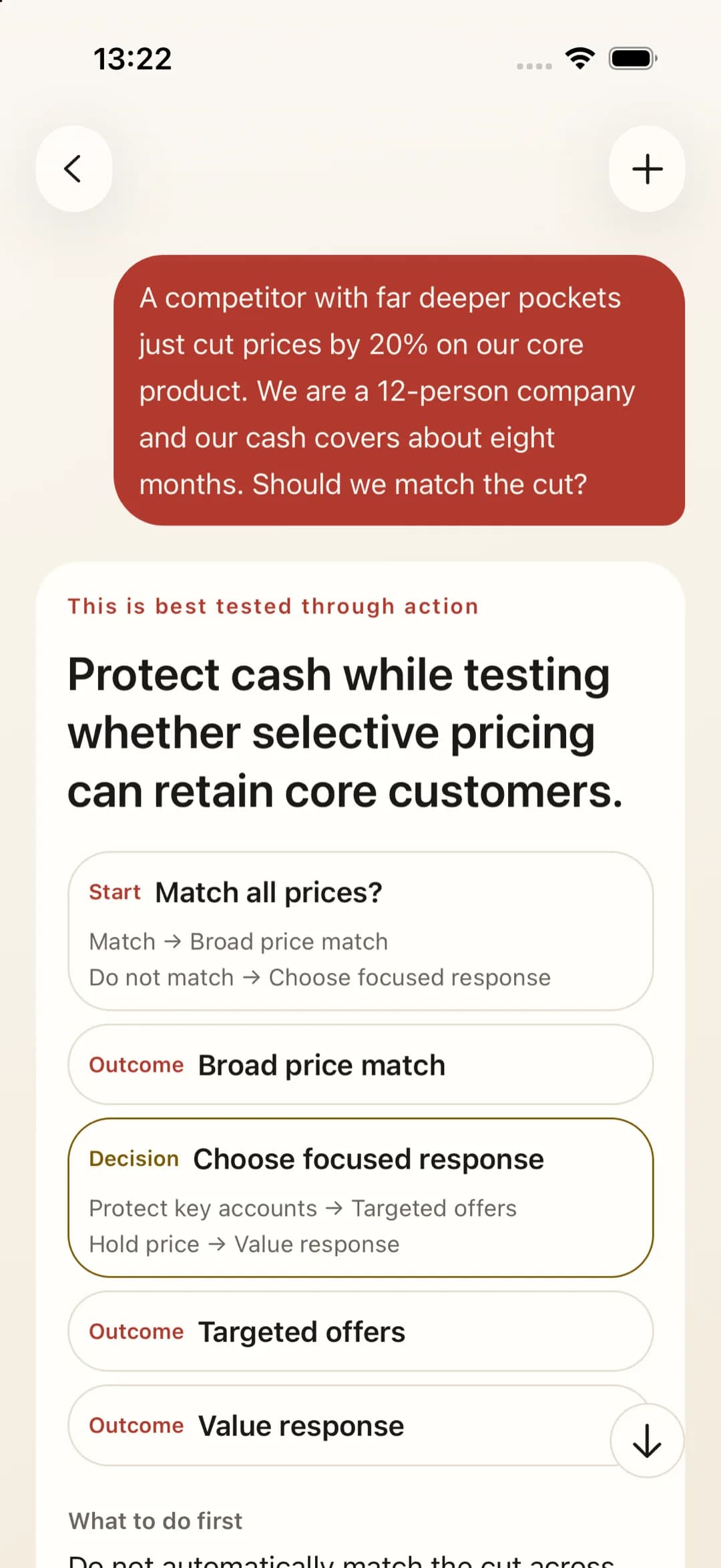
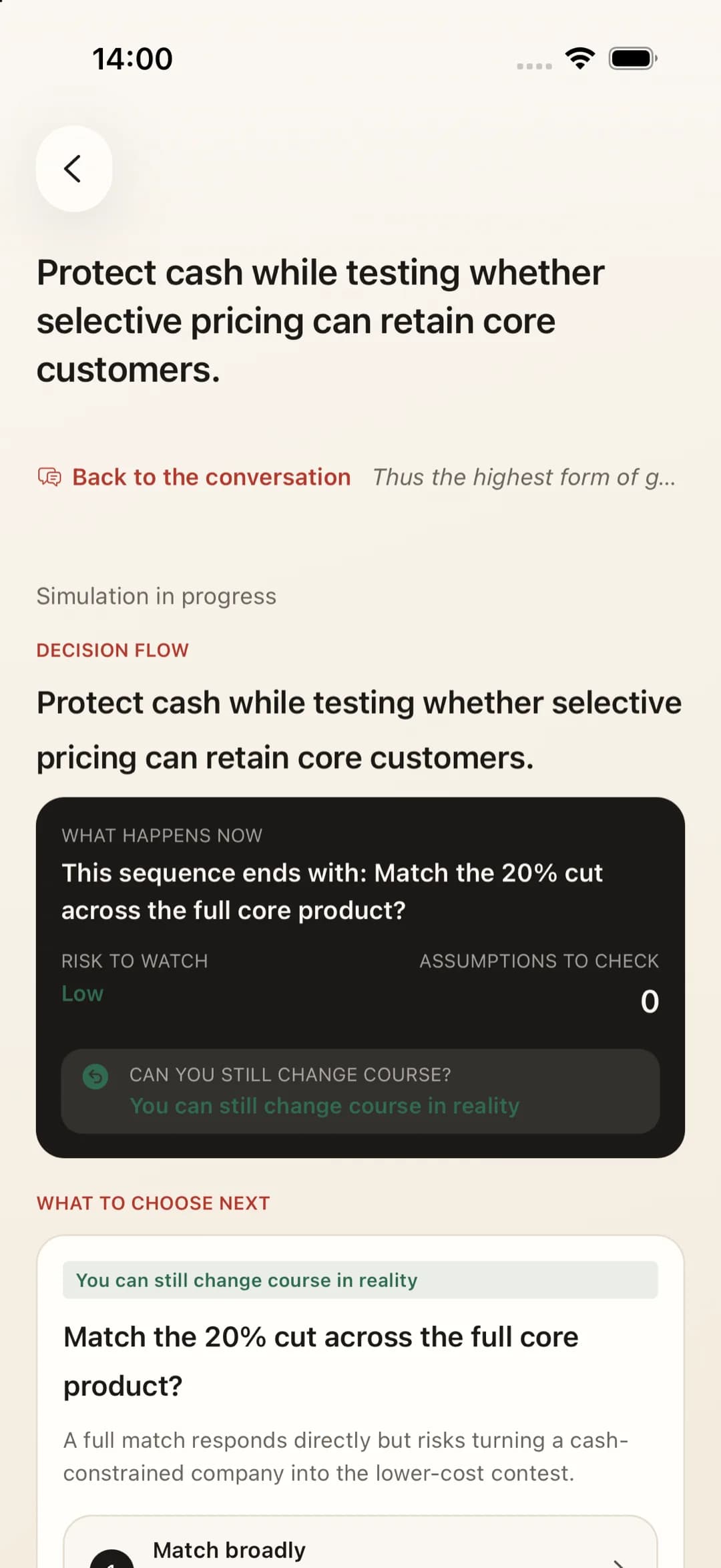
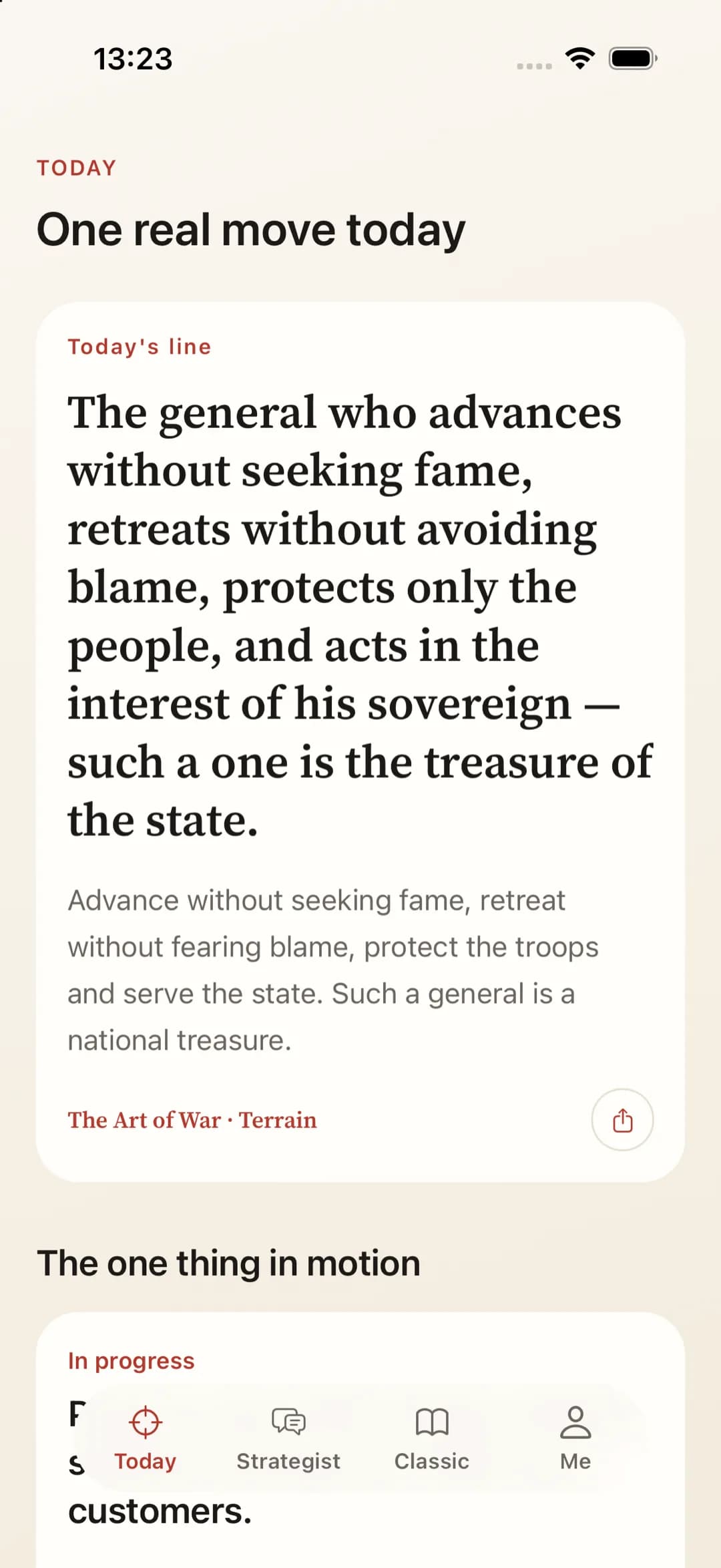
The strategist asks about your situation first, then gives a judgement and what to do firstLay both sides on the table and simulate whether the conclusion changesOne real move today, with a signal to watch
Tell the strategist about the project: who the client is, the value, the timeline, which people it needs, and what those people are doing now.
The strategist first asks about the client's budget and owner, then lays out the project's claim on your existing paths, what it leaves behind, and the exit conditions in one comparison.
You leave with an action card: one thing to confirm with the client this week, and a stop signal that tells you when not to take it.
This page covers the order of judgement. Your own situation, opponent, and resources are worked through with the strategist in the app.
The client is in a hurry and wants an answer now. What do I do?
Urgency is their constraint, not yours. Reply the same day with a clear date: proposal and quote within three days. Clients with real budgets can wait three days. The ones who cannot usually do not have the budget approved yet.
We have little work right now. Should I take whatever comes?
That is when the calculation matters most. Taking a low-priced project that fills three months while idle locks the team exactly when you most need to find new customers. Take it if you must, but keep part of the time and people free for prospecting.
How do I decline a project politely?
Give the reason and an alternative, not just a no. For example: our schedule is full for three months, and if you can wait we will prioritise you; or recommend a suitable team. A clear refusal protects the relationship better than a vague yes followed by delays.
What if I accept and then realise we cannot finish?
Say so as early as possible. Tell the client immediately and offer two options: a reduced scope on time, or the full scope with a later date. Waiting until the delivery date costs the client trust and costs you the final payment and the next project.
This page covers the order of judgement and is not legal or financial advice. Contract terms, payment guarantees, and intellectual property ownership require qualified professionals.