When co-founders clash, first work out whether it is a disagreement about direction, about roles, or a breakdown of trust, then decide whether to talk rules, division of labour, or separation.
The short answer
Co-founder conflict is rarely about one event. It is about one event exposing rules that were never spelled out: who decides, who owns what, and how gains and losses are shared.
The order of judgement is: what the conflict looks like on the surface, and whether underneath it is a disagreement about direction, about roles, or a breakdown of trust. The first two can be solved with rules. The third is a conversation about how to separate.
Do not discuss the biggest issue at the moment of highest emotion. Agree the smallest joint decision first, such as who has the final say in which area, and use one instance of keeping it to test whether the relationship can still be repaired.
Also searching for: co-founder conflict how to resolve · co-founders disagree what to do · founder dispute startup · co-founder relationship breaking down
Where people usually go wrong
Letting friendship stand in for rules
Because you are old friends, roles, equity, and exit terms were never written down. When the conflict comes, the friendship and the rules go together.
Recruiting the team to a side
Each founder confides in key employees, and the team is forced to choose. Whoever wins, the team is already split.
Treating a difference in direction as a character flaw
The other founder insists on a different path and you start doubting their motives. Direction can be argued. Once motives are questioned there is no way back.
Waiting for it to pass
Hoping time will soften it. Startup conflict does not fade. It resurfaces, larger, at the next funding round or the next bad quarter.
Three things to check before acting
What the conflict is reflecting
List the last three arguments and check whether they are the same kind: all about direction, all about who decides, or all about whether the other person told the truth. The category decides the remedy.
Whether the rules are written down
Equity, voting rights, each founder's area of authority, exit terms. If none of this is in writing, that is the root of the conflict. Fix the rules first.
Whether trust is still there
Do you still believe the other founder's numbers, promises, and reasons? If not, talking about roles and rules is cosmetic. The real subject is how to separate.
What Sun Tzu would look at first
The Art of War, chapter 3, Attack by Stratagem
Those whose upper and lower ranks share the same desire will win.
Sun Tzu lists shared purpose among the five ways of knowing who will win. Co-founders are not ranks, but the point holds: if you want different things, every tactic cancels out in execution. Confirm first whether you both want the same thing, then discuss how. If what you want is truly different, separating is also a form of shared purpose.
Three versions, three plays
The disagreement is about direction and trust is intact
Write down the assumptions behind each path, agree a metric that can be tested within three months and a fixed decision date. Until then, run one founder's plan. On the date, let the data decide, not whoever argues loudest.
The disagreement is about roles and each thinks the other oversteps
Add rules. Define each founder's area of final say, agree how cross-area decisions are made, write it down, and tell the core team. Most of the friction comes from the few decisions both of you assumed were yours.
Trust has broken down
Stop trying to repair the partnership and discuss how to separate: equity buyback, handover of responsibilities, the external message, and a timetable. Bring in a third party both of you trust, and treat it as a negotiation, not a trial.
How the app walks you through it
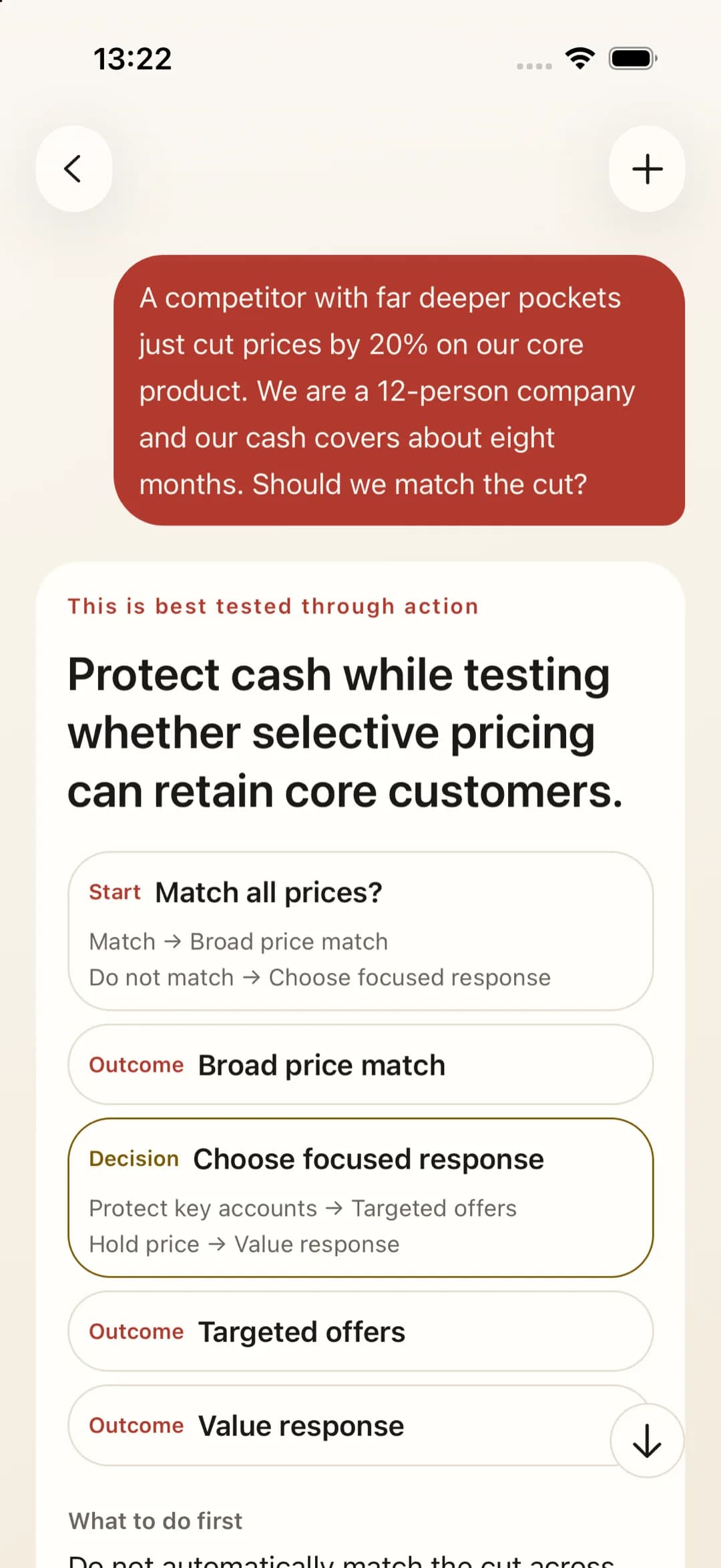
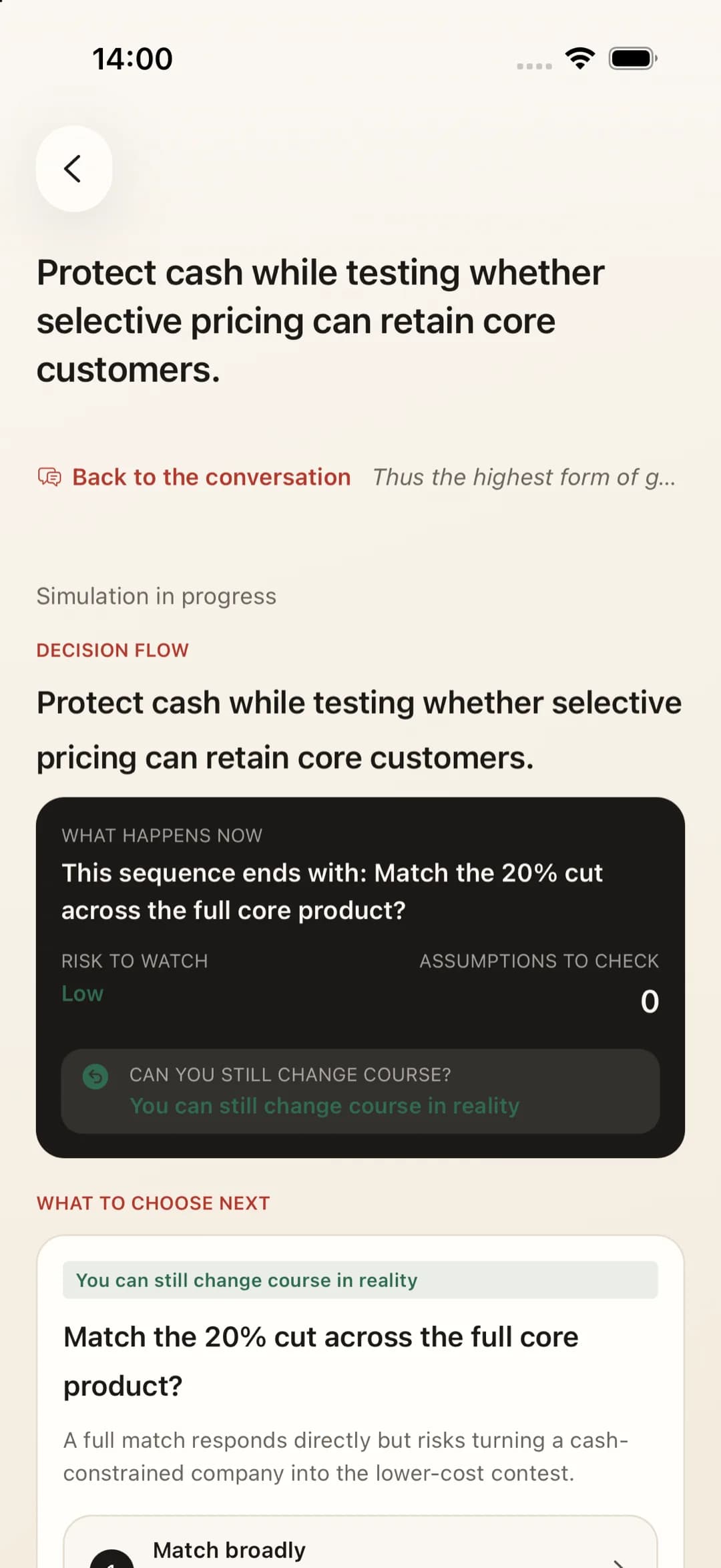
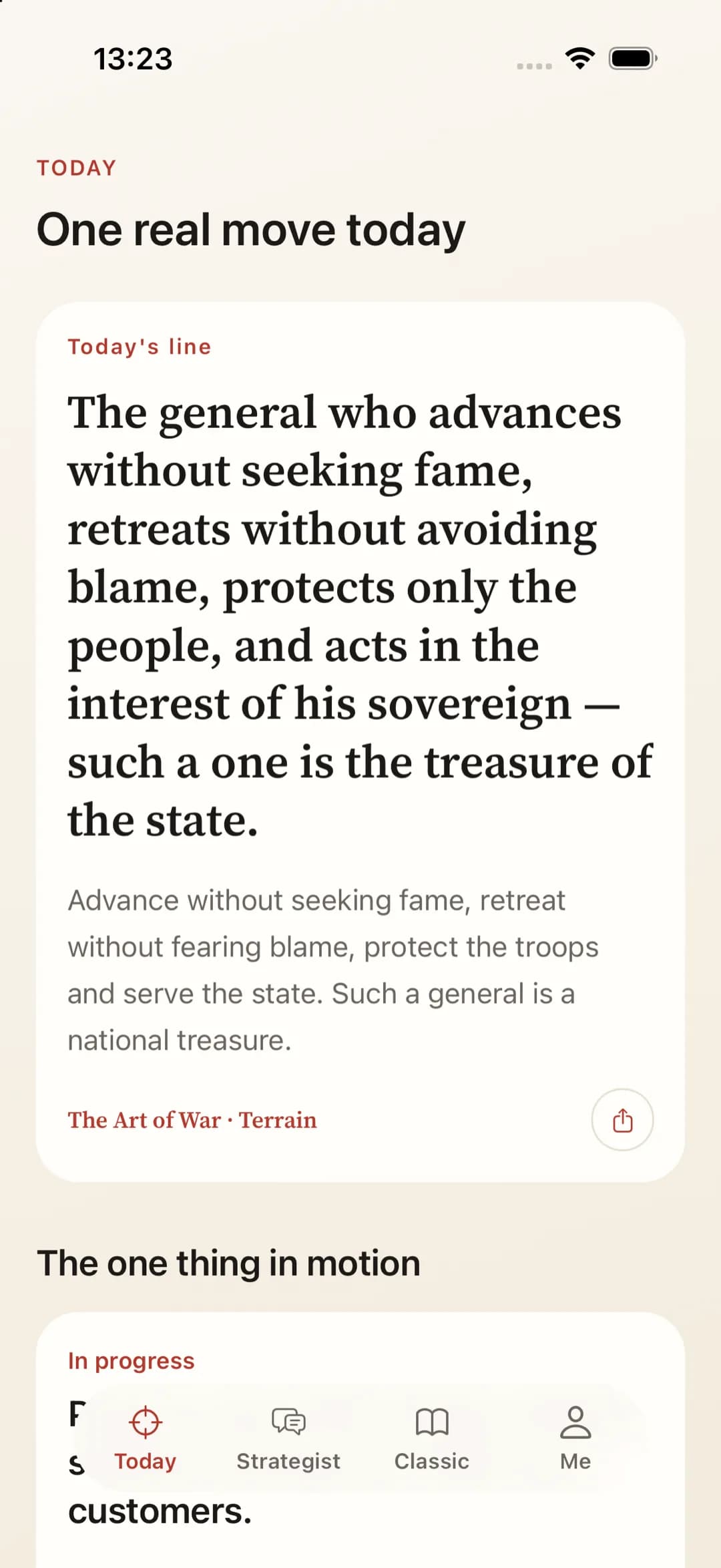
The strategist asks about your situation first, then gives a judgement and what to do firstLay both sides on the table and simulate whether the conclusion changesOne real move today, with a signal to watch
Tell the strategist what happened: what the recent arguments were about, whether equity and roles are written down, and whether you still believe what the other founder tells you.
The strategist first classifies the conflict, direction, roles, or trust, tells you which one your signals point to, and proposes one smallest joint decision to match.
You leave with an action card: the single thing to discuss in the next conversation, plus a signal that tells you the relationship cannot be repaired.
This page covers the order of judgement. Your own situation, opponent, and resources are worked through with the strategist in the app.
Should we bring in investors or the board to mediate?
For disagreements about direction or roles, yes, because they care about the company. For a breakdown of trust, be careful. Investor involvement usually means one founder leaves, so decide first whether you are ready for that.
How do I know whether the conflict can be repaired or we should separate?
Make one small joint decision and keep it. If even a small agreement cannot be kept, or you no longer believe the other founder's numbers, it is time to discuss separating. If it holds, the conflict was mostly rules that were never written.
Should we tell the team about the disagreement?
Tell the team what you are resolving, not each founder's position. The team needs to know where the company is going, not who is right.
How is equity handled if we separate?
According to the exit terms you agreed in advance. If there are none, have a lawyer and a financial adviser assess it before discussing buyback price and instalments. Do not negotiate a price while angry.
This page covers the order of judgement and is not legal, financial, or equity advice. Buybacks, articles of association, and founder agreements require qualified lawyers and financial advisers. Do not use Sun Tzu's language to justify coercion or mistreatment of a partner.